
Melianthus
Author: Ivan Lätti
Photographer: Francelle van Zyl
Melianthus is a genus of evergreen shrubs and undershrubs in the Melianthaceae family, ranging in height from 1 m to 3 m. The plants often have an unpleasant smell for which several have received the Afrikaans common name of kruidjie-roer-my-nie (little-herb-touch-me-not).
The compound leaves are alternate, the leaf structure imparipinnate, meaning a terminal leaflet is present at the leaf tip. The leafy stipules are often large and conspicuous. The leaf rachises are winged. The leaflets have unequal sides and toothed margins. Some of the species have hairy leaves.
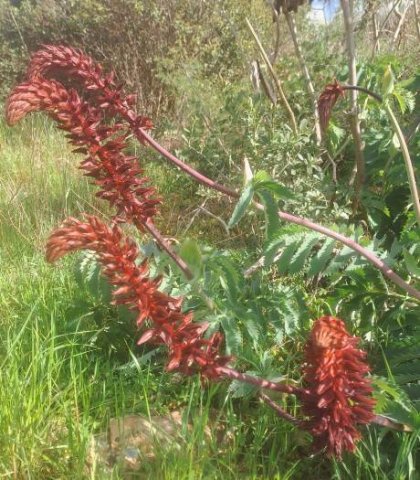
The generally bisexual flowers grow in racemes, from one to four at each node. The large, asymmetrical calyx is five-lobed and hairy on both sides. There is sometimes a sac-like pouch or gibbosity at the base of the calyx. A large disc is present at the flower base, variably linked to the sepals. A flower has five spoon-shaped, dissimilar and clawed petals, in some only four.
The four stamens arise from the nectary, the filaments free. The superior ovary is four-lobed, comprising four locules. There are two to four ovules in each locule. The persistent style is usually hairy at its base.
The generic name, Melianthus, is derived from the Greek words meli meaning honey and anthos meaning flower, referring to the abundant, often coloured nectar attracting mainly birds and also insects. The plants are sometimes also commonly called honeyflowers.
The sometimes-hairy fruit is a woody, leathery or membranous capsule, four-lobed or four-winged. The shiny, black seeds lack arils.
There are six Melianthus species, all in southern Africa, found in arid or moist places. Some of the plants feature in horticulture. The plants are very toxic but used as antiseptics and otherwise medicinally.
The plant in picture is Melianthus major (Leistner, (Ed.), 2000; Manning, 2009; Wikipedia).