
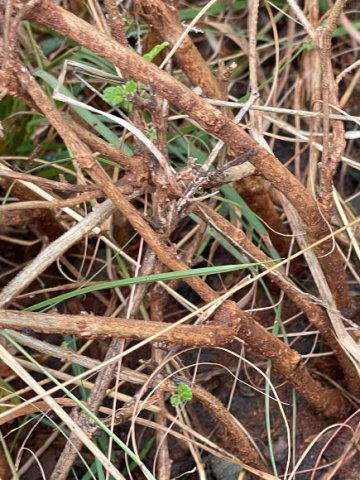
Lippia rehmannii leafless lower stems
Author: Ivan Lätti
Photographer: Elrich Linde
The bare, lower stems of a Lippia rehmannii shrub vary in shades of brown to whitish or grey, although the grey ones in picture may be dead. The stems vary in thickness, some thinner ones are present low down. This is because the plant is low-growing, normally covered overall in an about green dome below which leaves drop off when they don’t see sun. The bark is fairly smooth, apart from superficial roughness from tiny protuberances.
Additional shoots may grow from the ground around the main stem. This may point towards a resprouting capability, a feature consistent with lower-growing, multi‑stemmed species dominating in disturbance‑prone, shorter vegetation (Germishuizen and Clarke, 2003; Leistner, (Ed.), 2000; Van Wyk and Malan, 1997; Kruger, et al, 1997: Resprouters vs reseeders in South African forest trees; a model based on forest canopy height. Functional Ecology, 11, 101–105; iNaturalist).