

Erica melastoma
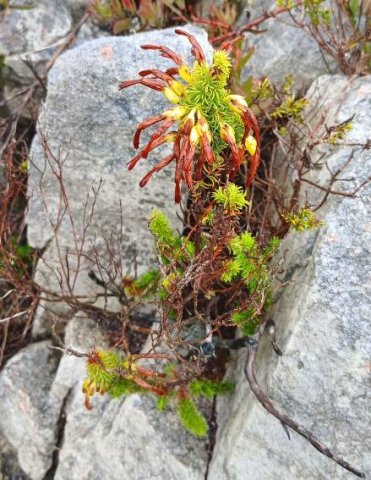
Author: Ivan Lätti
Photographer: Wikus Riekert
Erica melastoma, commonly known as black-mouthed tassel heath and sometimes as blackrim heath, is an erect shrublet reaching 1 m in height. It grows numerous, short side-branchlets.
The needle-like leaves ascend in whorls of three, concentrated on the side-branchlets. There are tiny bristles along the leaf margins pointing forward.
The flowers nod stalkless from short branchlet tips near the ends of the bigger, erect branches. The bracteoles resemble the sepals and clasp them from behind. The lance-shaped sepals often resemble the petals. The urn-shaped, somewhat inflated corollas vary in length between the two subspecies, greenish yellow to orange yellow in colour, often with a dark brown tip.
The specific name, melastoma, is derived from the Greek words, melas meaning black or dark and stoma meaning mouth, referring to the dark corolla tips. The plant in picture seen near Hermanus has lost most corolla colour, most sepals still yellow but no dark corolla tips.
The eight long, thin anthers are conspicuous like those of E. coccinea, exserted far. The greenish style is exserted even further, its stigma tiny.
The species distribution is in the Western Cape from the Cederberg to the Hottentots Holland Mountains and Agulhas. The photo was taken near Hermanus.
The habitat is fynbos slopes. The habitat population of the more widespread subspecies, subsp. melastoma, is deemed of least concern early in the twenty first century, while that of subsp. minor with shorter, bulbous corollas growing only from Hermanus to Bredasdorp, is considered threatened due to agriculture and alien vegetation invasion.
The plant in picture is probably subsp. melastoma (Manning and Helme, 2024; Andrew, 2017; iNaturalist; http://redlist.sanbi.org).