
Perdicium capense
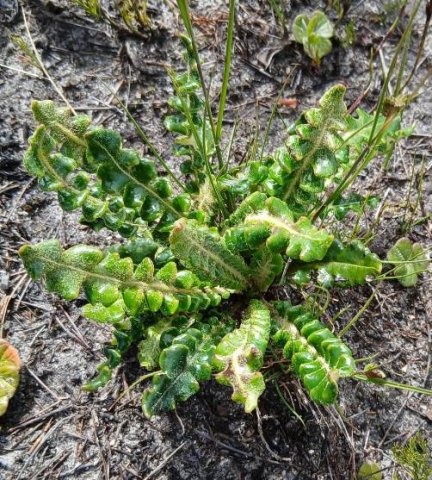
Author: Ivan Lätti
Photographer: Wikus Riekert
Perdicium capense is a tuberous, stemless perennial growing one or more ground-level leaf rosettes. It reaches heights around 15 cm when flowering.
The leaves are oblong and lobed, the midribs thick and conspicuous, the margins variably incised. The leaf lobes bulge or wave unevenly, their margins rolled under, or a bit of all of those, irregularly shaped with lateral lobes alternating unevenly. The green leaf surfaces are hairy or glabrous above and below, sometimes even woolly below.
The flowerheads are solitary on naked peduncles, tending to nod not far above the leaves that are angled up and out. The heads are disciform, the involucres scaled, and the bracts lance-shaped with pointed tips. There are no ray florets, the disc florets white. The peripheral disc florets are female, the central ones bisexual. Bloomtime is late winter to after midspring.
The brush-like pappuses are yellow to pale brown, bristled.
The species distribution is in the west of the Western Cape, and slightly into the southwest of the Northern Cape, from south of Caledon to the Bokkeveld Mountains, and the Avontuur Nature Reserve north of Nieuwoudtville. The photo was taken on the Tolbos farm in the Hemel and Aarde Valley.
The habitat is sandstone fynbos slopes and seasonally damp, clay renosterveld. Flowering is best after fire. The habitat population is deemed vulnerable, due to habitat loss and degradation, the plants never prolific (Curtis-Scott, (Ed.), 2020; Oettlé, (Ed.), et al, 2019; Leistner, (Ed.), 2000; iNaturalist; http://redlist.sanbi.org).