
Bobartia
Author: Ivan Lätti
Photographer: Ivan Lätti
Bobartia is a genus of evergreen, rush-like perennials, often forming large tufts, part of the Iridaceae family. They are commonly called rush irises and in Afrikaans blombiesies (flower restios). The plants are often found in rocky fynbos or renosterveld, adapted to seasonally dry, nutrient poor soils, and exposure to wind and sun. When flowering they are easily separated from the restios. The rootstocks are erect or creeping rhizomes.
The tough and wiry, reed-like leaves are mostly, erect, long and curving, crowded at the base. The leaves are linear to cylindrical in shape, usually with narrow grooves alternating with the veins. Some species have unifacial leaves without distinct midribs. Unifacial means cylindrical, terete, or flattened with both “sides” equivalent, rather than having a distinct upper and lower surface.
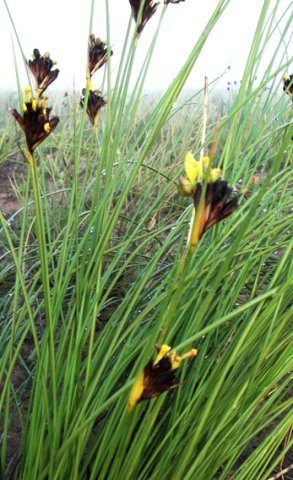
The naked flowering stems are branched or consist of one long internode with flower clusters at the stem tips, subtended by a leaf-like spathe that may be dry. The inflorescences are dense heads, the clusters called rhipidia. The pedicels are hairy. The short-lived, bisexual flowers are radially symmetrical or actinomorphic, several per rhipidium, each having six, usually yellow, spreading tepals. One species flowers blue. The tepals are free and without claws, the inner three slightly smaller. Only one species has flowers with a basal corolla tube.
The three stamens have free filaments and erect anthers that twist when dry. The inferior ovaries are three-locular, top-shaped or ovoid, sometimes included in the spathes. The style is short, dividing into three long, thread-like style arms with stigmas at their tips. These arms extend, alternating with the stamens.
The flowering of several species peaks after fire, or when the veld has been brush cut.
The woody fruit capsules are top-shaped, or ovate with smooth or tuberculate surfaces. The angular seeds have wrinkled surfaces.
There are about 15 Bobartia species, all occurring in the Western Cape and the Eastern Cape.
The plant in picture may be Bobartia filicaulis (Leistner, (Ed.), 2000; Vlok and Schutte-Vlok 2015; Manning, 2009).