
Kalanchoe
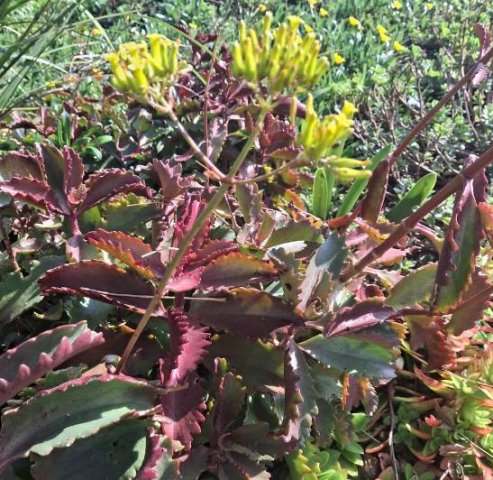
Author: Ivan Lätti
Photographer: Francelle van Zyl
Kalanchoe is a genus of fleshy, branching and spreading shrublets and shrubs in the Crassulaceae family. The generic name, Kalanchoe, is derived from the Chinese name of one of the species, kalan cauhuy meaning that which falls and grows. The lower stems may turn woody, the plants often regenerating from the base.
The simple, opposite leaves are stalked and free, stem clasping or fused. The leaves are thickly fleshy or succulent, sometimes deciduous, and rarely regenerating from the base.
The inflorescences are thyrses consisting of several dichasia, varying in the number of flowers. Peduncles may be present, the leaves often grading up the stems into bracts near the flowers. The stiffly erect or spreading flowers have calyces of four sepals each. A red or yellow corolla consists of four petals in a tube- or urn-shape, longer than the lobes at the mouth.
A flower has two whorls of four stamens each, the filaments attached to the corolla tube are hairless. The anthers, included in the corolla tubes, have nearly spherical appendages. There are four carpels in a flower, the style ending in four stigma parts. Nectar glands are present in the corolla base.
The seeds are ellipsoid showing central constrictions, ribs and grooves.
There are about 200 Kalanchoe species worldwide, found in Africa, Madagascar, Asia and Australia. The 13 southern African species occur in the summer rainfall region.
The plant in picture is Kalanchoe sexangularis (Leistner, (Ed.), 2000; Manning, 2009).