

Athanasia trifurcata achieving mature height
Author: Ivan Lätti
Photographer: Wikus Riekert
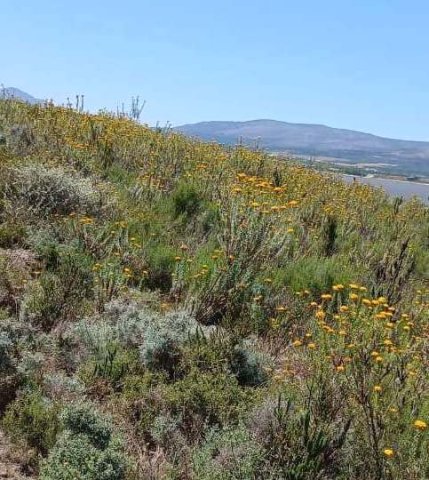
Athanasia trifurcata is flowering well on this sunny, dry slope near the Bot River Lagoon in November. Compact inflorescences, each comprising many heads, are spaced at roughly similar heights on stem-tips in each bush.
The flowering height clearly depends on age as seen in the younger bushes, although mature ones mostly don’t exceed an almost "agreed" mature height for the conditions prevailing on the hill. Most stop height growth at the level their neighbouring kin adhere to. A species has a “genetic ceiling” for given conditions, but many factors contribute to how close every plant gets to that.
To sustain the unexpected, there are always the few boisterous ones that exceed conventions and expectations. The exception proves the rule, as the saying goes; the cop-out used when biological phenomena beat the boundaries. And particular factors exist for explaining each of those occurrences, sometimes hard to find.
A plant’s genetic potential manifests in aspects including branching pattern, maximum internode length, woodiness, stem thickness, hormones and the behaviour of the meristems at its tips. Meristems are tiny growth regions, “engine areas” where clusters of continually dividing cells let the plant grow as long as it lives. These small growth areas are found in shoot tips, root tips and the cambium where bark is formed; quite unlike animals that grow all over their bodies until mature.
When a plant stops growing in height, the particular meristem areas slow down, or switch jobs in answer to hormonal messages. They become dormant, maintain, or switch to functions like flowering. This is how any plant species maintains its typical height, while some growth continues, although no longer in height. Lateral meristems may continue to grow side-shoots and thicken stems, while root meristems will add new root growth (Manning, 2007; iNaturalist; Wikipedia; https://www.britannica.com).