
Aulax
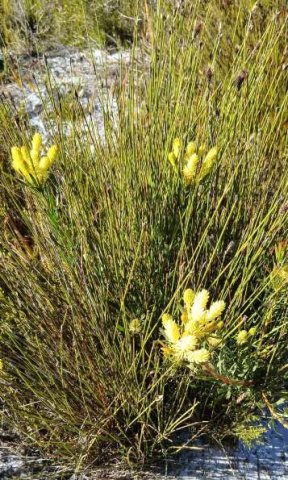
Author: Ivan Lätti
Photographer: Wikus Riekert
Aulax is a genus of erect, hairless shrubs in the Proteaceae family, commonly known as featherbushes.
The simple, leathery leaves are alternate and needle-like to linear or spoon-shaped. The leaves provide the simplest clues for species identification.
The plants are dioecious, i.e. the male and female flowers occur on separate plants. The flowers grow in short racemes on a central column surrounded by incurving branchlets that sometimes also bear flowers, forming a globose head.
The male inflorescence is a loose, spike-like, stem-tip raceme. The yellow flowers are tubular with the clawed perianth limbs united at the base, the lobes free. The filaments emerge from the base of the perianth.
The female inflorescence is a woody cup of incurving branchlets and involucre, the flowers borne on a conical central column. These yellowish and green flowers have superior, ovoid, hairy ovaries, each containing one ovule, the perianth around an ovary hairless, its four limbs free. The slightly curved style is cylindrical, ending in an oblique stigma.
Sterile styles are present in the male flowers, sterile staminodes in the female flowers. Floral nectaries are absent from flowerheads of both sexes. Pollination by insects is confirmed for two species, inferred for Aulax pallasia.
Flowering happens in spring and summer.
The fruit is egg-shaped, wider near the tip and white-haired. It is an achene, a single, dry seed. Only about twenty percent of Aulax seeds germinate.
There are only three Aulax species, all occurring in Western Cape fynbos. They are hardy garden plants.
The plant in picture is A. cancellata entangled in a restio near Hermanus (Leistner, (Ed.), 2000; Manning, 2007; Rebelo, 1995; Wikipedia).