
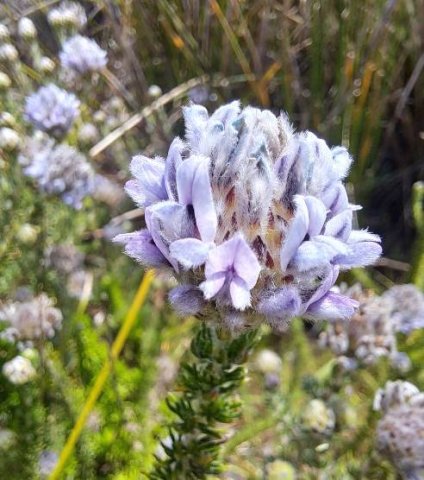
Aspalathus globulosa inflorescence
Author: Ivan Lätti
Photographer: Francelle van Zyl
The flowers of Aspalathus globulosa grow in solitary, globose heads at the tips of the sometimes much-branched stems. There are from eight to twenty-five flowers in an inflorescence, each flower subtended by a leafy, ovate bract with broad base and acutely pointed tip. The bract surfaces are hairless to partly and sparsely hairy, while the margins are conspicuously white-haired or ciliate, the hairs long. The sometimes-glossy bract surfaces are green but usually turn brown soon, starting from the top. There are also smaller, simple bracteoles below each nearly sessile flower.
The peaflower-like corollas are bluish-violet, sometimes with some white, or altogether white. The erect banner petal is folded vertically down the centre, hairy on the outside. The narrow wings are long and narrow or elliptic, pointing forward or erect and curved in over the keel. They are often hairy on the outside surfaces, sometimes only on the lower parts. The keel is small and hairy, sometimes erect, often bluish violet.
Flowering happens from before midspring until early summer (Privett and Lutzeyer, 2010; Bean and Johns, 2005; Bond and Goldblatt, 1984; iNaturalist).