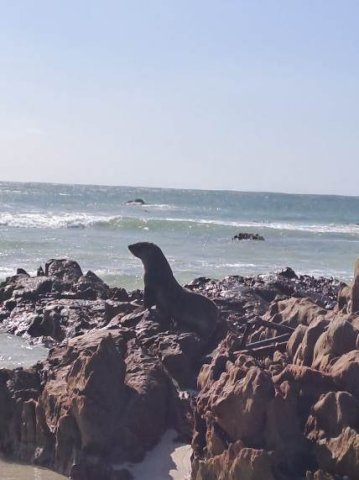
Seal sentinel of the moment
Author: Ivan Lätti
Photographer: Francelle van Zyl
Why a seal in a plants website? All animals, including seals, may serve as narrative doorways to the ecological truth that plants never exist alone. The coastline is a living system of geology, ocean, climate, nutrient flows, and animals shaping vegetation patterns. The Cape fur seal, or the Afro-Australian fur seal, scientifically known as Arctocephalus pusillus, forms part of this living edge where fynbos meets the sea.
The Latin word, pusillus, means tiny or insignificant. This seal does not fit that description. The choice of this name is yet another bit of lore in the gradual growth of information and knowledge that often begins small, and may later leave funny or embarrassing effects. Someone called von Schreber conferred the first scientific species name on this seal around 1776, accompanied by a description in a German journal called Säugethiere (mammals). He had never seen the seal, so the story goes, using the skin of a trader-supplied juvenile, and no explanation offered for the name choice. Firsts have to be recognised. They are seldom the final word on anything. And killing seals must have started very long before that, as people and other animals had to eat!
There are several other kinds of fur seals in the sea, and occasionally visiting land near the high-water mark. But here, near Betty’s Bay, the long, dog‑like muzzle, brown coat, body shape and characteristic posture on the warm rocks is typical of the animal named, the habitat and region fitting.
In South Africa this seal, subsp. pusillus, is slightly bigger than its Australian counterpart, subsp. doriferus. The local male weighs about 250 kg and is about 2,3 m long, the female slightly smaller. It has long whiskers and external ear flaps. The fore-flippers are partly hairy and black; the hind flippers short with fleshy tips. The males are darker brown than the females, some grey ones also found, the manes hairy.
The fur seals breed on beaches among pebbles, rocks or boulders. The pups are born black. They cannot swim or forage independently for many months. Pups are weaned just under or over a year, but yearlings sometimes sneak a suckle, their mothers obliging or not.
These seals, A. pusillus subsp. pusillus, are found from Namibia southwards to the Cape Peninsula and eastwards to Gqeberha. The Cape fur seal is an obligate carnivore, meaning it has to eat meat for its nutritional requirements, whether it occasionally ingests anything else, like plant material or not. The predators that eat them are mainly great white sharks, orcas, and occasionally southern elephant seals.
So, these seals, never far from the coast in the sea, never far from the sea on the land, play a role in a very busy ecological zone that involves the prevailing plant life directly and significantly. The Cape fur seals are major contributors of marine‑derived nitrogen and phosphorus to coastal soils: Their guano, their ongoing activities, and later their carcasses enrich their shared living quarters. This influences algae growing on the rocks, modifies microhabitats for things like lichens, and leaves nutrients for plants of the strandveld.
Like many of the other residents of, and visitors to the almost endless, meandering line where land meets sea, fur seals trample vegetation in a sealy manner, interfere with goings on among dunes, and polish rocks. Socially they attract and interact with all sorts of predators and scavengers from both land and sea. They belong here (iNaturalist; Wikipedia; https://www.gbif.org; https://speciesstatus.sanbi.org).