
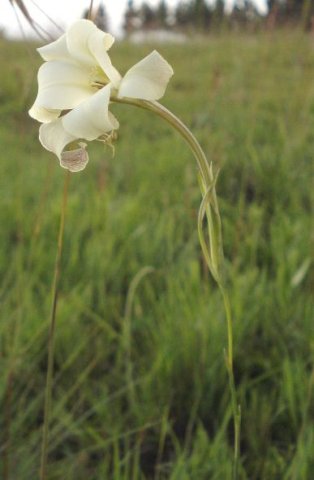
Gladiolus longicollis subsp. platypetalus tepal curling
Author: Ivan Lätti
Photographer: Judd Kirkel Welwitch
This Gladiolus longicollis subsp. platypetalus flower in an expanse of Highveld grass recurves its lowermost tepal more strongly than most in its subspecies. This overdone curve reveals the fine speckling of the flower on the outside of its corolla. Mpumalanga plants like the one of the photo, the more northerly group in the species, are less speckled than those growing further south.
The curved corolla tube is as thin and long as the plant normally produces, making its pollination a more exclusive affair than happens in the many accessible, opener flower species that welcome allcomer pollinators, endowed with mouths of all shapes and sizes.
All living bodies are specialised in some ways, some more exclusively. The more exclusive, the bigger may be the survival risk, especially where dependence on other specialised species, such as pollinators is involved. Safer in the generalist crowd is at least a short-term advantage, while unravelling of such populations via speciation due to different challenges across the species distribution range, changes the survival chances of resulting smaller subgroups.
So, specialisation isn’t only for insects, flowers, elephants, and academics. It is a widespread phenomenon that takes time. Speciation takes its time as well, as evolution waits for so many deaths, timed before or after breeding, to get things done (Goldblatt and Manning, 1998; iNaturalist).