
Hartmanthus pergamentaceus
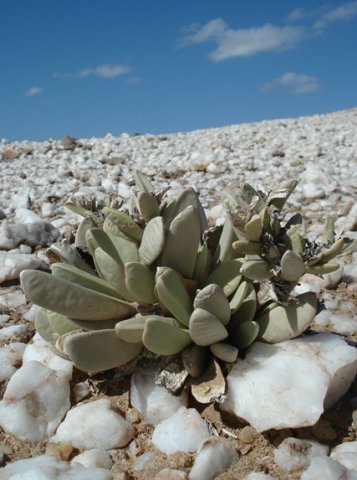
Author: Ivan Lätti
Photographer: Judd Kirkel Welwitch
Hartmanthus pergamentaceus, sometimes commonly called elephant’s ears or withering neatfig and previously scientifically Delosperma pergamentaceum, is a dwarf shrublet, a leaf succulent of the mesemb family that reaches heights around 12 cm. The plants form spreading though compact, ground-level clumps, the old stems becoming woody.
The paired leaves grow equal and thickly succulent from stem-tips, triangular in cross-section due to a strong keel. The coarse blade surfaces are silvery or greenish grey, the margins sometimes reddish in full sun. Leaf dimensions are up to 7 cm long, 1,5 cm wide, and 2 cm thick.
The white or rarely pink petals surround a yellow-anthered stamen cone in each flower. Bloomtime is mostly late winter to early spring. A fruit capsule has six locules, lacking closing bodies and covering membranes.
The species distribution is in the west of the Richtersveld in the north of the Northern Cape near the Gariep River, also in the extreme southwest of Namibia.
The habitat is arid scrubland to desert, partly receiving evening mist from the sea. The plant in picture thrives in quartzite gravel in full sun on a gradual slope. The habitat population is deemed of least concern early in the twenty first century (Smith, et al, 1998; iNaturalist; Wikipedia; https://www.botanikks.com; http://redlist.sanbi.org).