
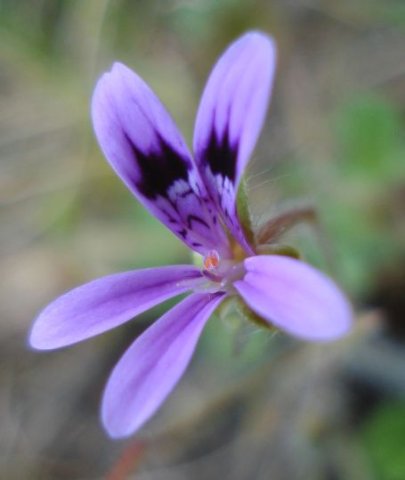
Pelargonium columbinum young flower showing anthers
Author: Ivan Lätti
Photographer: Judd Kirkel Welwitch
The young Pelargonium columbinum flower shown here has two visible anthers above its centre, brimming orange with pollen. There are usually four anthers in a flower. Filaments lacking anthers are also present. The five branches of the flower’s style haven’t separated yet, in picture still only a blue purple rod below the anthers.
Protandry is the phenomenon by which many plants minimise self-pollination. The male component, the anthers mature first, releasing their pollen to insects when ripe. Only later does the style elongate, split into its five spreading branches, and become receptive to pollen from other flowers, brought unintentionally by hungry pollinators. In this species the pollinators are small, flying insects, visiting only because they seek food. Capable of crawling into the narrow, elongated hypanthium of each flower where the nectar is produced for them, or endowed with long proboscises that can reach into tubes, they are fed for their troubles, i.e. the pollination services provided, a good dee of which they are eternally unaware.
As a functionally designed pollinator attracting device, the two-lipped, blue purple to magenta corolla in several shades, spreads its five round-tipped petals conspicuously. The upper pair of petals are covered in variable dark markings, the lower three unmarked, the flower sure to be noticed (Bond and Goldblatt, 1984; iNaturalist; https://www.fernkloof.org.za).