
Portulacaria
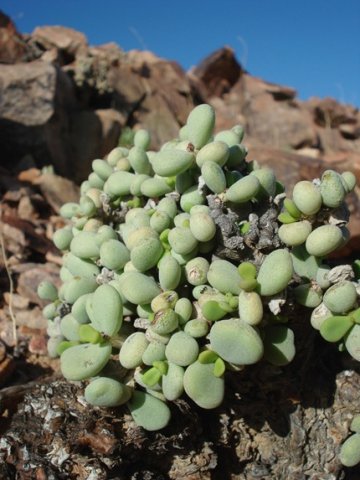
Author: Ivan Lätti
Photographer: Judd Kirkel Welwitch
Portulacaria is a small genus of succulent shrubs and small trees in the Didiereaceae, previously the wider Portulacaceae family. The hairless plants have brittle stems with smooth bark that may be waxy. Some dwarf species hug the ground, while at least one becomes up to 4 m tall.
The simple, opposite leaves are succulent, their shape ranging from obovate and round to narrow or cylindrical.
The flowers are fascicled at stem-tips. A flower has two membranous, persistent sepals. The petals are joined in short tubes ending in four or five obovate lobes. There are four to seven stamens fused to the petals in each flower, some losing their anthers early. The superior ovary is three-winged or three-angled but has only one locule containing one ovule at its base. The style is short, ending in three slightly spreading stigmas. The fruit is a three-winged, thin-walled nut that does not burst open when ripe.
The Portulacaria genus of seven species is indigenous to southern Africa. Five species occur in South Africa, with spekboom, Portulacaria afra the most well-known, even celebrated. It grows naturally across thousands of hectares in South Africa and has become important in the quest for carbon sequestration and the reduction of greenhouse gases. Planting large numbers in high rainfall regions seems, however, not to do much for the carbon in the air problem, while overdoing it in regions where the plant is not naturally common may affect the local biodiversity negatively. The many plants seen in gardens do no harm, can be encouraged. Some portulacarias are fodder plants, their acceptability to stock being variable due to the uneven presence of tannin.
The plant in picture is P. pygmaea (Leistner, (Ed.), 2000; Vlok and Schutte-Vlok, 2015; Coates Palgrave, 2002; Wikipedia; https://www.facebook.com/spekboomsa; https://www.getaway.co.za).