
Nerine sarniensis some plant details
Author: Ivan Lätti
Photographer: Francelle van Zyl
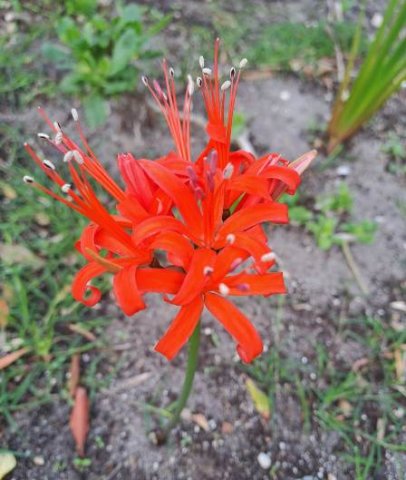
The flowering Nerine sarniensis plant in picture has a green, smooth, about erect stem but no leaves at the time when the flowers are there.
The globose, underground bulb in grey-brown outer tunics has an upwardly produced, partly aerial neck. The bulb forms offsets or bulblets that vegetatively propagate the plant from the bulb’s basal plate. The clonal bulblets are genetically identical to the bulb, unlike bulbs grown from seed that had a pollen grain fertilising an ovule.
The four to seven strap-shaped leaves are shallowly channelled, smooth and nearly erect to spreading or recurved. They are green or blue-green, becoming from 20 cm to 32 cm long.
The six red or sometimes pink tepals of each flower recurve, strongly at their tips. The tepals are nearly regular and equal, meaning that the flowers are nearly radially symmetrical or actinomorphic. From behind the tepals in picture one of the pinkish beige, pointed spathe valve tips is protruding in the upper right.
Six stamens cohere in their lower parts, spreading over the flower centre in their upper parts. The filaments are red in different shades or sometimes white, varying in length around 4 cm. The shortly oblong anthers start off maroon, in picture black at the back and for the rest nearly white here from the pollen that is usually creamy.
The styles look similar to the stamens but are longer, their stigmas minute and whitish here. The inferior ovaries below the styles are globose and green, about 3 mm wide.
The fruit capsules to follow are nearly globose, from 8 mm to 11 mm wide. The ellipsoid seeds are green (Duncan, et al, 2016; Manning, 2009; iNaturalist).