
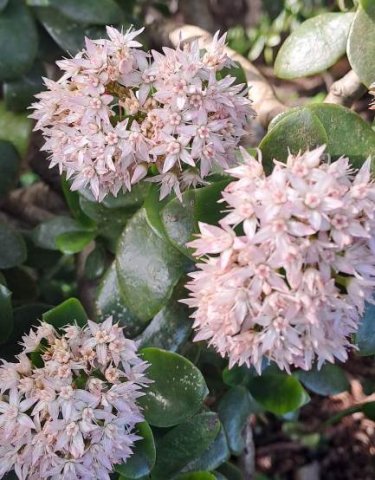
Crassula ovata lush blooms, shiny leaves
Author: Ivan Lätti
Photographer: Francelle van Zyl
Lavish pinkish white inflorescences over glossy, dark green, succulent leaves confirm wellbeing of this Crassula ovata plant. This is fine for the good times, but what about dry and trying times?
Some crassulas (and many other plants) have evolved a special water conservation method by closing their leaf stomata or pores during the day, preventing moisture loss. This means they forfeit the chance of accessing CO2 for photosynthesis during the day. Water is retained, but what about the need for plant feeding through photosynthesis while the sun shines?
These specialised plants take in CO2 through their opened pores at night, and store it as organic crassulacean acids for using the next day when the sun shines. Water loss through open pores in the cool of night is much less. When the sun shines, these crassulas, and other plants including Mesembryanthemum crystallinum, photosynthesise normally by breaking the night-stored acids down for use as CO2 in their photosynthesis during the day.
C. ovata is one of the crassulas that makes some use of this metabolic system. There are others that use the system more. The method is called Crassulacean Acid Metabolism or CAM, one of evolution’s long-time developed solutions for overcoming drought. In our time it may come in handy for more plant species, as climate change bites deeper. But CAM has already been found operating in at least 370 genera of vascular plants, maybe functioning to some extent in around 7% of all of them.
Adaptation to conditions is life’s answer to the existential questions facing all species. They are resolved in creative ways without human intervention, creation not being over, and will never be as long as something is alive.
How many of nature's solutions will not be for us to see? How can we find all the answers when we are part of the living experiment, just one of a million species on one planet of the billions of planets, where all kinds of things have been going on for thirteen thousand million years? Maybe some future generations will have even greater opportunities to marvel and explore. But we are having a hell of a ride in the twenty first century (Smith, et al, 2017; Gilman, et al, 2023: The CAM lineages of planet Earth. Annals of Botany. Vol. 132(4), pp 627–654; iNaturalist; https://pza.sanbi.org).