Quercus suber, the cork oak
Author: Ivan Lätti
Photographer: Francelle van Zyl
The Quercus or oak genus has no species indigenous to South Africa. In fact, their family, the Fagaceae or beech trees, is not represented by any species indigenous to South Africa. So, what is an oak tree doing in this website?
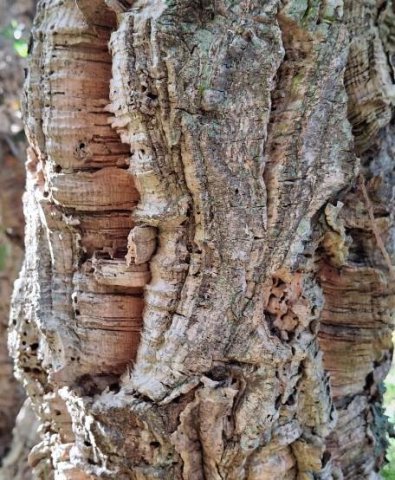
The excuse for introducing a Quercus suber photo in this South African plants website relates to the story of the farmyard rooster that called all the hens together when the first ostrich on their farm laid an egg. “You see what can be done?” was his motivational speech. Many photos of the trunks of local trees are shown in this site, displaying their bark. The bark of Q. suber serves as an example of what can be done in that regard.
The first oak trees introduced in South Africa were Q. robur, the English oak, planted in the seventeenth century. Many others followed and particularly Q. palustris, the pin oak, and Q. suber, the cork oak, are well-known local trees today.
Q. suber, a medium-sized, evergreen tree, grows naturally around the western parts of the Mediterranean Sea, in countries of southern Europe and northern Africa. Semi-natural cork oak forests occur in Portugal and Spain, where trees of the species have been managed for centuries in the production of cork. The bark is harvested repeatedly without killing the tree, making this one of the most sustainable commercially exploited tree species in the world.
The Western Cape climate suits the cork oak very well. The photo was taken in Fernkloof at Hermanus (iNaturalist; Wikipedia; https://www.biodiversityexplorer.org).