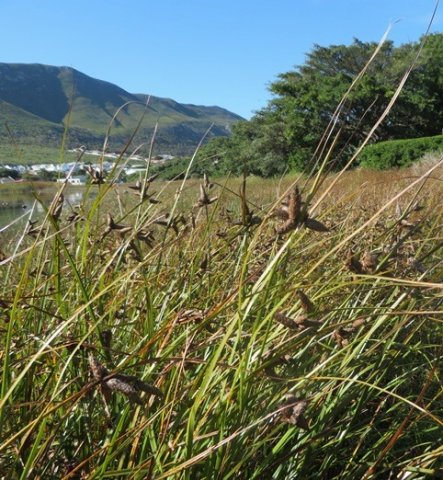
Bolboschoenus maritimus
Author: Ivan Lätti
Photographer: Francelle van Zyl
Bolboschoenus maritimus, commonly known as the sea clubrush, in Afrikaans as snygras (cut grass) or snyruigte (cut brushwood), and previously scientifically as Scirpus maritimus, is an often-robust, grass-like perennial reaching heights from 1 m to 1,5 m.
The solid, three-angled (triangular in cross-section) stems are solid, their bases swollen, tuber-like where they connect with the rhizomes. The generic name, Bolboschoenus, is derived from the Greek words bolbos meaning a bulb or onion, and schoenos or skhoinos meaning a rush or reed, literally meaning a bulbous rush. This probably refers to the tuberous swellings.
The species distribution is worldwide in warm areas near water. In South Africa B. maritimus has probably been naturalised long ago, in the Western Cape, the Eastern Cape, the Northern Cape, and a little in Gauteng. Naturalised here means the species has established a self-sustaining population outside its native range without ongoing human assistance. The photo was taken at the Vermont Salt Pan near Hermanus.
The habitat is wetlands, mostly near the sea, in riverine vleis of warmer regions, where the plants thrive in organic rich, muddy flats, mostly at elevations below 300 m. The specific name, maritimus, is a Latin word meaning situated by, connected with or occurring along the sea, referring to part of the distribution being near the sea (although much of it is near water, not the sea). The habitat population is deemed of least concern early in the twenty first century.
The fruits, the nutlets, have been eaten by people since times immemorial. The tuberous underground parts were, however, regarded more important as a food. The plants are widely used in wetland restoration (Curtis-Scott, et al, 2020; Leistner, (Ed.), 2000; Pooley, 1998; Bond and Goldblatt, 1984; iNaturalist; https://pza.sanbi.org; https://redlist.sanbi.org).