
Ficus burkei figs
Author: Ivan Lätti
Photographer: Francelle van Zyl
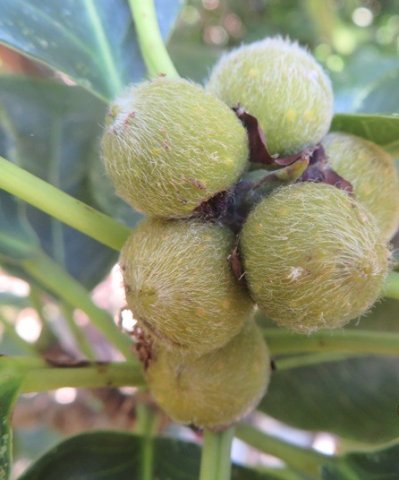
The fruits of Ficus burkei are small figs borne solitary or in pairs from leaf axils, stalkless or sometimes on the shortest of stalks. These fruits are often aggregated in dense clusters among the leaves near stem-tips.
The globose figs are initially pale green, grey green or yellow green, mature at about 1 cm in diameter, and often become reddish when ripe. They usually start off hairy; the whitish hairs may diminish or disappear as the fruits ripen. Below the figs in picture small, hard basal bracts are visible. These bracts are not always equally visible, but feature more in this species than in some others, although all fig trees have some kinds of bracts that initially enfold the fruit growth beginnings. The basal bracts on this tree stand out quite clearly as dark scales beneath the figs. Figs may be doubled in size when galls form inside them, triggered by certain wasps.
No less than 28 wasp species are known to live with trees of the F. thonningii complex that includes F. burkei, pollinating the internal syconium florets, while reproducing their own next generation of wasps there. some of these species only use this kind of fig tree. Some fig species have only one dedicated wasp species living with its trees in symbiosis. Coates Palgrave tells a fascinating tale about wasp doings inside their figlet haunts or syconia.
Maybe the F. thonningii complex can spread more easily into different ecological regions from the benefit of being pollinated by different species (Coates Palgrave, 2002; Schmidt, et al, 2002; Van Wyk and Van Wyk, 1997; Pooley, 1993; iNaturalist).