

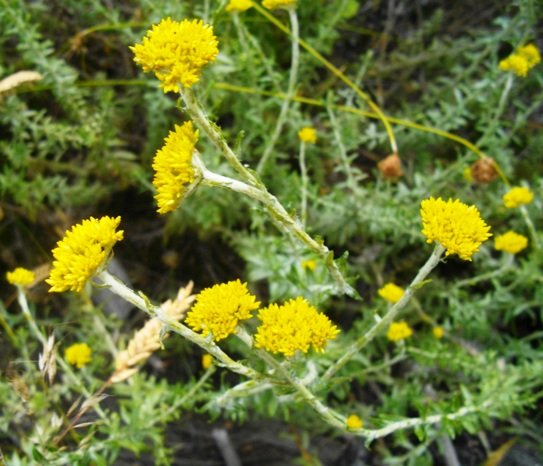
Helichrysum cymosum subsp. cymosum young flowerheads
Author: Ivan Lätti
Photographer: Thabo Maphisa
Mature Helichrysum cymosum subsp. cymosum shrubs may spread to 1 m in diameter. The many young branch-tips tend to the vertical though, the flat-topped inflorescences growing at the tips of upright stems. Younger plants appear more erect before the spreading commences, a bit like people. This young Fernkloof plant with its straggling tangle of stems not exposed to full sun all day, looks much greener than one might expect of the species in midsummer.
There are white velvety stems with sparsely scattered alternate leaves up to the flowerheads. Leaf margins are slightly rolled under.
The individual flowerheads forming large, showy, flat-topped inflorescences are narrowly cylindrical, each encircled by yellow bracts. The discoid (fertile) flowerhead comprises a dense cluster of bisexual florets, or also has some female ones around the margin of the disc in a disciform head.
The specific name, cymosum, is derived from the Greek word kuma meaning a swelling. The word has reached modern usage for the inflorescence shape called a cyme via Latin in which cyma also means the young sprout of a cabbage (Euston-Brown and Kruger, 2023; Vlok and Schutte-Vlok, 2015; Manning, 2007; iNaturalist; Andrew, 2017).