

Disa sagittalis
Author: Ivan Lätti
Photographer: Judd Kirkel Welwitch
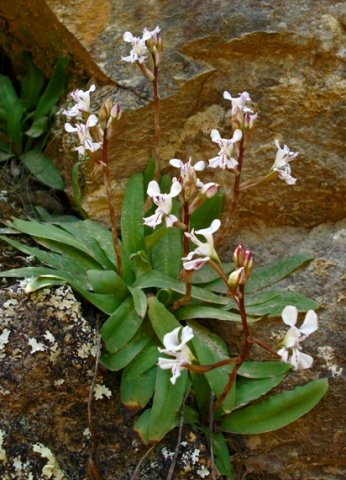
Disa sagittalis, sometimes commonly called the X disa, is a small orchid reaching heights from 7 cm to 30 cm. This is an epilithic plant, not a ground orchid, as it does not grow in the ground, but on above-ground rock surfaces (as do, for instance, also most seaweeds).
The five to ten spreading to semi-erect basal leaves, arranged in rosette formation, are strap-shaped to narrowly elliptic and taper to pointed tips. The leaf margins are entire, the centre of the leaf being shallowly recessed in a longitudinal channel. The leaves become up to 9 cm long. The stem leaves are small, by flowering time reduced to dry, overlapping sheaths (up to 2,5 cm long).
The species distribution occurs in the Western Cape from Swellendam and Barrydale to the Eastern Cape around Port St. Johns.
The habitat is shady rocks near streams or seeps, but also away from water on drier sandstone cliffs. The plants grow from the coast to altitudes around 2000 m. The habitat population is deemed of least concern early in the twenty first century (Liltved and Johnson, 2012; Pooley, 1998; iNaturalist; http://redlist.sanbi.org).