
Wachendorfia paniculata
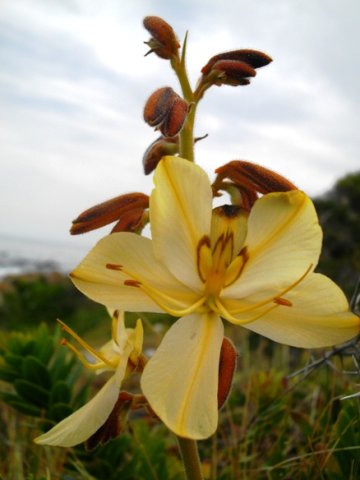
Author: Ivan Lätti
Photographer: Thabo Maphisa
Wachendorfia paniculata is a rhizomatous, variably hairy perennial that reaches heights from 20 cm to 70 cm when in flower. The rhizome from which the plant grows is red right through. The plant is said to flourish in the first season after fire.
W. paniculata has acquired a bewildering array of common names, paying testimony to the impact these flowers have made on people. Commonly known as butterfly lily, the story isn't simple. Butterflies are not the primary pollinators. The flower appearance has often enough suggested butterflies to human observers. Broad, flared tepals resembling wings in the loose, airy panicles, enhanced by the contrasting basal petal markings, and tepals often fluttering in wind on sunny days, all added to a plausible enough outcome.
In Afrikaans, on the other hand, several common names have come about: rooikanol (red bulb) refers to the plant's red rhizome, koffiepit (coffee pip or seed) alludes to the sometimes dark markings or nectar guides at the base of the upper tepals, while spinnekopblom (spider flower) is a little more tricky. Maybe from spiders nesting in the panicle, the loose inflorescence, or from a possibly spidery shape of the panicle itself.
The lanceolate leaves growing from the base are lengthwise fluted or pleated and hairy. The tips are acutely pointed, the blades slightly out-curved.
The flowering stem is erect. There are papery bracts below the flowers that are light yellow to apricot in colour with brownish markings at the bases of the upper tepals. There is also a marked darker yellow line running down the centre along the length of each tepal. Two stamens are sharply turned to one side and the third together with the pistil to the other. The buds are red brown before opening.
The species distribution is in the Western Cape from the Cape Peninsula to around Clanwilliam where different colour forms are found, and eastwards to the west of the Eastern Cape, as far as Gqeberha. This plant was photographed at Vermont near Hermanus in October.
The habitat is sandy and stony soils in moist places. The habitat population is deemed of least concern early in the twenty first century (Manning, 2009; Bean and Johns, 2005; iNaturalist; http://redlist.sanbi.org).