

Disa hallackii
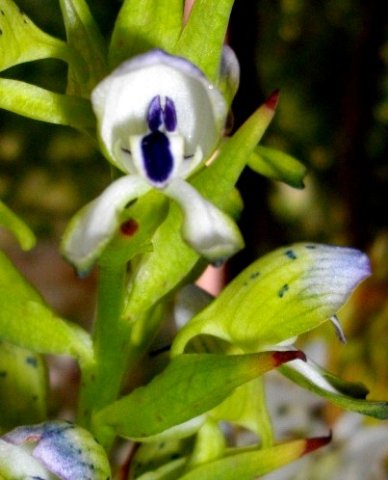
Author: Ivan Lätti
Photographer: Thabo Maphisa
Disa hallackii is a robust, tuberous perennial reaching 50 cm in height.
The imbricate (overlapping) leaves are lance-shaped and acute-tipped, sheathing the stem and continuing up to the inflorescence. They ascend around the stem, the margins slightly wavy and sometimes red. There may also be red blotches on both the stem and the lower parts of the outer leaf surfaces low down on the plant.
The species distribution is in the Western Cape from Saldanha and the Cape Flats along the coast to the Eastern Cape as far as Gqeberha (Port Elizabeth).
The plants grow in fynbos, scrub and ticket at lower elevations and in coastal sand. The species is rare in nature. The habitat population is considered threatened early in the twenty first century, mainly due to development and human activity along this popular coastline (Liltved and Johnson, 2012; Privett and Lutzeyer, 2010; iNaturalist; http://redlist.sanbi.org).