
Rauvolfia afra
Author: Ivan Lätti
Photographer: Ivan Lätti
Rauvolfia afra, commonly the quininetree and previously scientifically R. caffra, occasionally grows to great heights of about 20 m in conditions where ample water allows for this at forest edges (SA Tree List No. 647). More often it is only a small to medium sized tree.
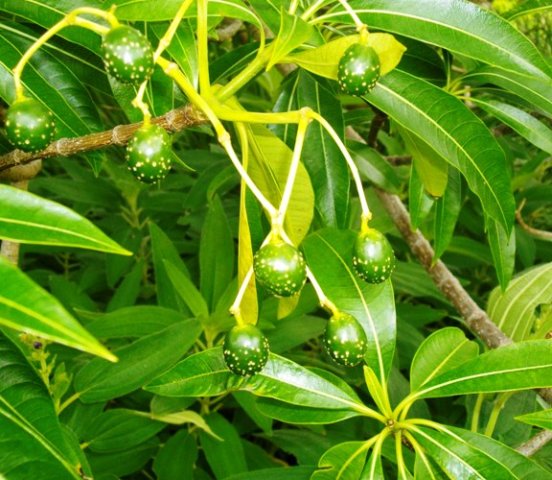
The leaves grow in whorls crowded at the end of the branchlets. They are simple, narrow, obovate to elliptic and have entire margins. Leaves tend to be slightly leathery, shiny above and pale below, with conspicuous net-veining evident on both surfaces.
The fruits are fleshy green drupes covered in the white spots that can be seen in the picture. These fruits become dark purplish and wrinkled as they ripen.
The species distribution is in the Western Cape from the southern Cape to the Eastern Cape, KwaZulu-Natal and the provinces north of the Vaal River, also in many other African countries.
The habitat is woodland and forest, particularly riverine forest, swamp forest and forest margins at lower altitudes. The habitat population is deemed of least concern early in the twenty first century.
The tree resembles Breonadia salicina, the mingerhout (Afrikaans) or matumi, which lacks the milky sap or latex found in the quininetree. This latex played a role as a malaria cure in the past, without positive results. The bark does, however, contain a substance used effectively as a tranquiliser and in reducing blood pressure. Various parts of the tree are used in a multitude of traditional remedies. The wood is soft and pale, suitable for making curios and woodcut objects.
The tree belongs in the Apocynaceae or dogbane family, hence the latex. While this species is the only one occurring naturally in South Africa, the Rauvolfia genus comprises about 85 species, many of them evergreen trees that grow naturally in tropical areas (Coates Palgrave, 2002; Pooley, 1993; iNaturalist; Wikipedia; http://redlist.sanbi.org).