
Erica nabea flowers
Author: Ivan Lätti
Photographer: Francelle van Zyl
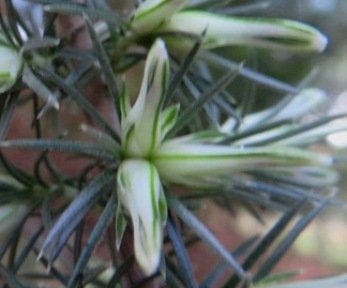
The rather drab green and white flowers of Erica nabea are unique in their sepals being longer than their petals that are about hidden. The flowers grow solitary or in groups of up to three from the tips of short-shoots on very short to negligible pedicels. The papery bracteoles are lance-shaped, about half as long as the sepals. In picture the bracteoles are keeled green, veering away from the long, narrow calyx bodies.
Each flower-dominant, large calyx consists of two unequal, opposite pairs of sepals, an outer and an inner pair. These four sepals are narrowly lance-shaped and white with green keels, narrowed in their upper parts, forming a beak-like structure that conceals the petals and anthers. The sepals are from 12 mm to 15 mm long. The white petals inside are erect, only up to 4 mm long, together forming an unseen urn-shape.
The stamens are well longer than the corolla but not reaching the sepal tips. The style is similarly taller than the stamens, shorter than the sepals, its tip hooked at the included pinhead-like stigma.
Flowering happens from late autumn through winter (Manning and Helme, 2024; Bond and Goldblatt, 1984; Baker and Oliver, 1967; iNaturalist).