
Cotyledon tomentosa subsp. ladismithiensis
Author: Ivan Lätti
Photographer: Thabo Maphisa
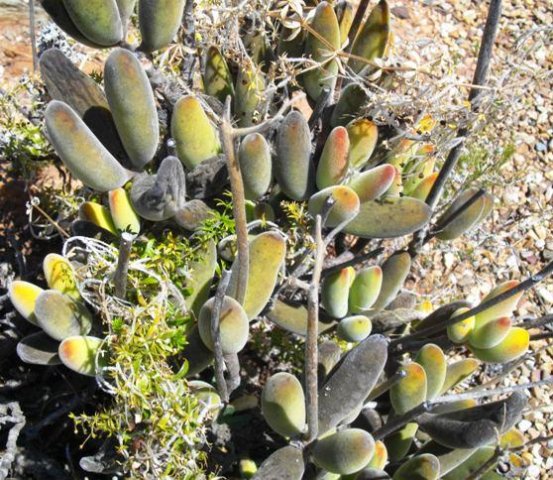
Cotyledon tomentosa subsp. ladismithiensis is a rare succulent that branches strongly, reaching about 1 m in height (including the inflorescence).
The leaves are oblong-elliptic or almost cylindrical (with only one sharp tip or rarely up to three apical teeth), yellow-green and tomentose. These tips are sometimes reddish. The term tomentose means plant hairs that are bent and matted, forming a woolly coating. The pendulous red flowers resemble those of Cotyledon orbiculata.
The distribution is in the Western Cape, mainly in part of the Little Karoo south of Ladismith, and a few locations near Laingsburg.
The habitat is rocky outcrops in shale renosterveld. The habitat population is deemed endangered early in the twenty first century, due to illegal harvesting and habitat degradation.
The subspecies differences occur in plant size (subsp. ladismithiensis being bigger), leaf-tip teeth, and flower orientation. Subsp. ladismithiensis flowers spread more or are more outward facing on stouter pedicels, while subsp. tomentosa flowers nod more or are pendulous (Vlok and Schutte-Vlok, 2015; iNaturalist; http://crassulaceae.net; http://redlist.sanbi.org).