
Albums
Albuca cooperi
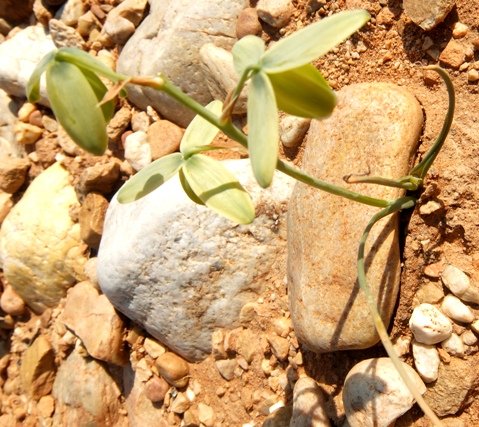
Author: Ivan Lätti
Photographer: Thabo Maphisa
Albuca cooperi, commonly known in Afrikaans as the geldbeursie (little money purse) or blougif (blue poison), and previously scientifically as A. karooica, is a deciduous geophyte growing annual leaves in winter from the perennial bulb. It reaches heights ranging from 35 cm to 60 cm. The tops of the outer bulb scales decay into split fibres.
Two or three, sometimes four narrow, channelled leaves are grown. Their margins are rolled in and clasp the stem at the base where they are warty. Leaves become about 30 cm long, 1,5 cm wide at the base.
After flowering and fruiting in spring the plant has a dormant phase in the dry, hot summer.
The species distribution is widespread, from Namaqualand in the Northern Cape across most of the Western Cape to the western parts of the Eastern Cape. These flowers were seen near Oudtshoorn in the middle of August.
The habitat is stony slopes and flats in sandy or calciferous soils and coastal dunes. The habitat population is deemed of least concern early in the twenty first century (Vlok and Schutte-Vlok, 2015; Manning, 2009; iNaturalist; www.pacificbulbsociety.org; http://redlist.sanbi.org).