
Albums
Ochna
Author: Ivan Lätti
Photographer: Francelle van Zyl
Ochna is a genus of trees, shrubs and some shrublets, some growing underground stems and resprouting. The genus forms part of the Ochnaceae or wild plane family. The generic name, Ochna, is derived from the Greek word, ochne, meaning wild pear, referring to the resemblance between the leaves of some ochnas and the leaves of the tree that is today the pear, Pyrus communis.
The bark may be either smooth or rough, sometimes flaking. The plants are usually hairless. The growing tips are usually conical with overlapping bracts sometimes prominent.
The simple, alternate or sometimes spiralling leaves may be briefly deciduous in spring or during drought. Young leaves are often red. The petioles are usually short. Leaf shapes vary among ovate, obovate, oblong and linear. Leaf margins are often serrate, sometimes fringed, and rarely entire. The midribs are prominent on both sides, the lateral veins numerous, parallel, closely spaced, and curved up near the margins without forming one encircling vein. The net-veining is often distinct, venation more visible on the upper surfaces. There are small, fused, deciduous stipules between the petioles and the stems, sometimes with fringed margins, and often ending in two shallow lobes.
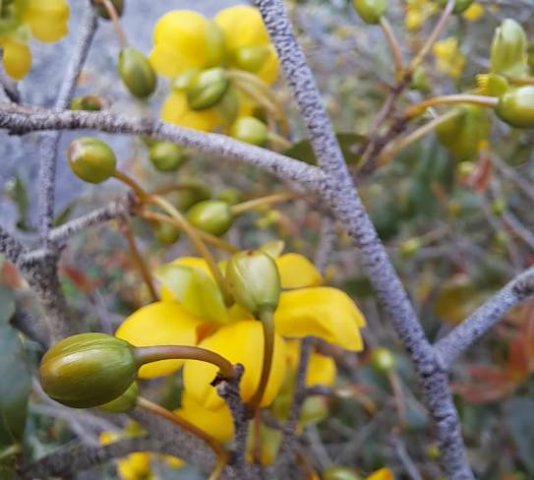
The often-fragrant, bisexual flowers grow at stem tips or from leaf axils, mostly on short spur-branchlets. They occur in panicles, racemes, cymes or solitary. The pedicels are jointed in their lower parts, continuing to grow as the flowers age. Bud scales or bracts are present, leaving scars on the twigs. There are five sepals in a flower. During the bud phase they are quincuncial, meaning two of them are exposed on the outside, two tucked inside, and the fifth halfway between, one edge exposed, the other covered. The firm, persistent sepals start off green or yellow, turning pink or red during fruiting. The sepals envelop both the buds and later the young fruits, spreading when the flowers are open, and when the fruits are ripe. The five to twelve petals are usually yellow, orange or rarely white, dropping off early. The petals are obovate in shape and attenuate or are clawed at the base.
The thirty to forty stamens of each flower are free, irregularly positioned in a whorl on the receptacle. The two-loculed anthers are fixed at the base to their thread-like filaments. The anthers open in side slits or at their tips. Each of the five to fifteen carpels of a flower contains one ovule. The styles arise from the base of the ovaries, united or free in their upper ends. The lobed stigmas at the style tops are as many as the carpels. One or more kidney-shaped drupelets may develop from one flower, all of them one-seeded. The seeds are kidney-shaped, curved or straight.
There are 86 Ochna species in Africa, Asia and on some islands. The twelve in southern Africa all grow in the summer rainfall region.
The plant in picture is Ochna serrulata (Leistner, (Ed.), 2000; Venter, 2012; Coates Palgrave, 2002; https://www.worldfloraonline.org).