
Orthochilus leontoglossus
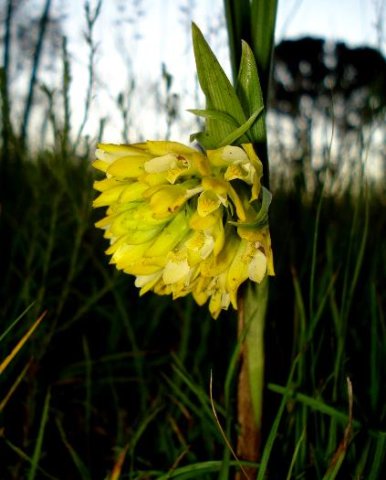
Author: Ivan Lätti
Photographer: Judd Kirkel Welwitch
Orthochilus leontoglossus, commonly known as the lion's tongue, in Zulu as iphamba, and previously scientifically as Eulophia leontoglossa, is a stout perennial, a terrestrial orchid growing leaves and flowers from a rhizome-like tuber and thick, fleshy roots. The plant reaches annual heights from 6 cm to 40 cm.
A few broadly lanceolate leaves are produced. They taper to acutely pointed tips, and conspicuous longitudinal veins run parallel to the leaf tips. The leaves may be taller than the inflorescence, as is the case in picture.
O. leontoglossus produces a dense, drooping spike of often yellow flowers. The petals and sepals, broadly obovate with attenuating tips, have entire margins. The lip is three-lobed, two small lateral ones and an acutely angular, central lobe that is large, round-tipped with a scalloped margins. The lip is the conspicuous part with fleshy, erect protuberances in the central area of its upper surface. This is what catches pollinator eyes.
The column deviates from cylindrical, bulging near the top where the anther cap is present. There are two, branched pollinia. Blooming usually occurs from midspring to midsummer.
The species distribution is in the east of South Africa, from the north of the Eastern Cape through KwaZulu-Natal and the Free State to Gauteng, Mpumalanga and Limpopo, as well as beyond the border in tropical Africa. The photo was taken near Nigel.
The habitat is dry to marshy grassland. The habitat population is deemed of least concern early in the twenty first century (Pooley, 1998; Lowrey and Wright, 1987; iNaturalist; iSpot; http://redlist.sanbi.org).