
Albums
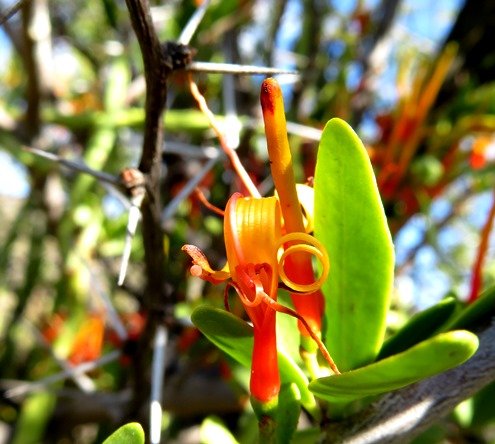
Moquiniella rubra flower and thorn tree spines
Author: Ivan Lätti
Photographer: Thabo Maphisa
The photo shows Moquiniella rubra open flower segments curled back, as well as a closed bud with already slightly darkened tip. The green calyx with no sepal lobes to speak of, is short. The recurving perianth segments are not yet parted to the base.
The long white thorns or spines on the dark branchlet of the Vachellia karroo tree used by this M. rubra plant as its host, remind of the parasitic nature of M. rubra.
Flowering of the parasite happens in autumn and winter.
An ellipsoid berry follows each successful flower. The fruit turns red when ripe, and up to 1 cm long (Vlok and Schutte-Vlok, 2015; Shearing and Van Heerden, 2008; Leistner, (Ed.), 2000; iNaturalist).