
Albums
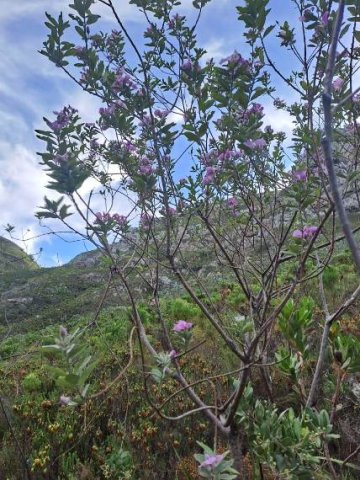
Podalyria calyptrata small tree
Author: Ivan Lätti
Photographer: Francelle van Zyl
The lanky Podalyria calyptrata bush is accepted as having crossed the border into tree status. Sparsely branched and tall here, the shrub form may be more compact, appearing denser.
Flowering is an abundant, seemingly enthusiastic affair, which is a good thing. The single-stemmed plant has to reseed from the underground seedbank, rather than resprouting from an own woody, underground base. Primary seed dispersal from the dehisced ripe pods is explosive, landing seeds at some distance. The fleshy collars or arils attached to the seeds may serve as ant food, bringing about secondary, further dispersal of the seeds.
Proof of this happening, or something like this happening involving dispersing agents, has been reported for P. buxifolia involving ants. Not explicitly recorded for P. calyptrata, but it can be regarded as a reasonable possibility, as the fleshy arils occur generally in the Podalyria genus (Manning, 2007; Bean and Johns, 2005; Leistner, (Ed.), 2000; iNaturalist; https://pza.sanbi.org).