
Albums
Bauhinia galpinii
Author: Ivan Lätti
Photographer: Dorette Potgieter
Bauhinia galpinii, commonly known as the pride-of-de-Kaap or in Afrikaans as vlam-van-die-vlakte (flame of the plain), is a shrub, sometimes a climber, occasionally a small, spreading tree reaching heights up to 5 m (SA tree List No. 208.2).
The species distribution is in the north-eastern parts of South Africa, the provinces north of the Vaal River and KwaZulu-Natal. Over the border it also grows in eSwatini, Mozambique, Zimbabwe and further afield in tropical Africa. The common name referring to De Kaap may confuse some as to the whereabouts of this plant in nature: the De Kaap Valley is near Nelspruit in Mpumalanga, nothing to do with the Western Cape where the plant does not grow in nature.
The habitat includes various kinds of woodland, thicket, scrub, bushveld and along watercourses, often where there is high rainfall. The habitat population is deemed of least concern early in the twenty first century.
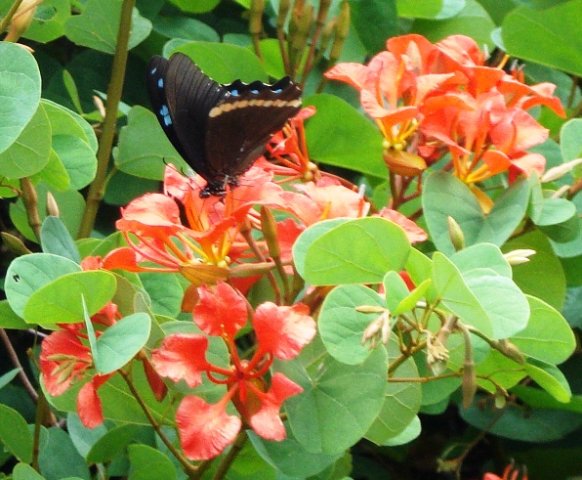
The flowers of Bauhinia galpinii have done much to promote the plant among gardeners and pollinators, as illustrated by the one in action here.
Decoctions of roots and seeds of this plant feature much in traditional medicine. Consider for a moment the panicky trial and error activities resorted to in treating illnesses that threaten loved ones. Long historical admixtures of guessing, luck and sudden insight accompany the real life discoveries of plant uses for particular medical conditions. Communication lapses of outcomes to younger generations, memory challenges taxing the aged when the need for the knowledge suddenly returns, and the school fees of relearning, all feature in subsequent applications. The human endeavour of curing illness has deep roots in knowledge forerunners of the laboratory knowledge of pharmaceutical science and chemistry.
Successful trials of new plants, those that did not kill their subjects, allow more ingredients into the social mix of stored discoveries. Components of recklessness, determination, panic, bravery and even cruelty hover and pass from human memory as the knowledge base expands.
There are probably too few monuments on earth in honour of ancient (and who knows how recent) medical guineapigs who succumbed, or became racked by guilt and grief. The unknown animal and human heroes or sacrifices of the profession represent milestones in the collective knowledge growth of our species (Manning, 2009; Coates Palgrave, 2002; Van Wyk and Gericke, 2000; Pooley, 1993; iNaturalist; www.plantzafrica.com; http://redlist.sanbi.org).