
Albums
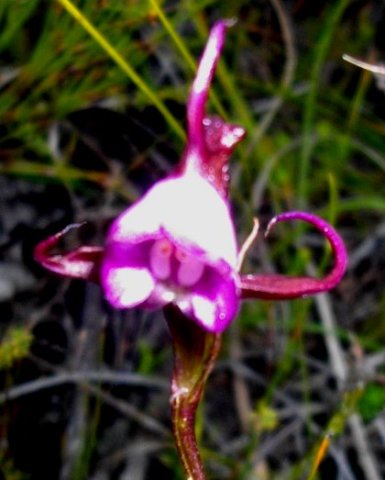
Disperis capensis var. capensis, one of the moederkappies
Author: Ivan Lätti
Photographer: Ivan Lätti
The solitary flower grown by Disperis capensis var. capensis is resupinate, i.e. twisted around so that the median petal or lip moves from its original bud position above the flower centre to below it.
The pair of lateral petals are small. They are joined to the dorsal sepal on its flanks, forming the hood over the plant’s sexual parts in the central column above the lip. The dorsal sepal is hairy inside. It has two notable pouches at the back, protruding in picture as the rectangular part above the white of the hood. The dorsal sepal ends erectly, the long thin tail curving up above the rest of the flower.
The pair of lateral sepals are pouched in their broader parts near the base, the tips spreading widely and curving up as they become thin like Dali’s moustache tips. So, this orchid actually has four spurs or pouches in one flower: a pair in the dorsal sepal and another pair in the lateral sepal pair.
There is also an informal Afrikaans name, a fynbos legend type name for the plant of nouisekkwaai (now I am cross), seen on Facebook on August 1st, 2026. This can easily be seen to relate to the two upturned lateral sepals, resembling a Boland farm tannie (auntie) who has been offended, standing with raised arms, meaning the same as hands on hips. The sepals are often green, the petals usually magenta; colour variations are common. The lip is fused to the column of the flower and clawed. Its blade is 8 mm by 2 mm. Flowering happens in winter and early spring.
Bearing no nectar as pollinator reward, this plant capitalises on mimicry. Fortunately, for it there is a Polygala flower, Polygala bracteolata, growing in a well overlapping distribution that confuses insects to visit and pollinate both flower species, rewarded only by the Polygala. Something like using a credit card at an ATM, receiving an insufficient funds message, and then succeeding at another machine (Liltved and Johnson, 2012; Manning, 2007; Bean and Johns, 2005; iNaturalist).