
Albums
Dracophilus dealbatus
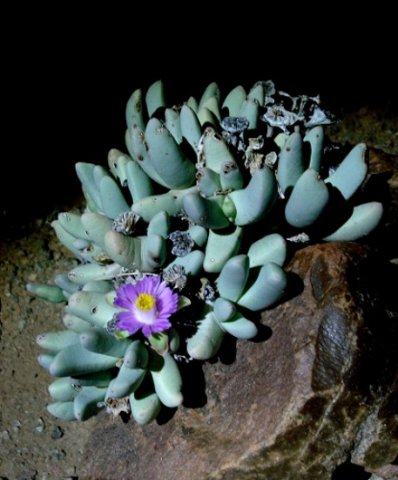
Author: Ivan Lätti
Photographer: Judd Kirkel Welwitch
Dracophilus dealbatus was previously scientifically called D. montis-draconis and D. proximus at different times since botanists took an interest in the plant. The range-restricted and remote species does not seem to have acquired common names. It is a branched but compact, dwarf leaf-succulent reaching about 30 cm in height. The species is monotypic, other specific names having disappeared after study.
The generic name, Dracophilus, is derived from a spot known as Drachenfels (dragon rock) in the Richtersveld where this mesemb was also found. Many of the early Richtersveld and Namibia botanists were German, people like Dinter, Schwantes and Range. Interesting how Fels (rock in German) became philus (friend), and more so, how dragon friends were ever spotted. Maybe the Richtersveld rock shapes? There is no connection between this plant and the Drakensberg Mountains, although the name D. montis-draconis might unintentionally suggest that.
The thickly succulent but variably shaped (and coloured) leaves are erect from the ground in similar, three-angled pairs, united at the base. There is mostly softening of angles towards a smooth, approaching cylindrical and round-topped shape. Leaf colour is pale grey-green, blue-green or yellow-green, sometimes pink at the tips where a tiny protruding spiny tip may be just visible. The finely textured leaf surfaces may have faint, waxy coverings. The specific name, dealbatus, is a Latin word meaning whiten or covered in white, albus meaning white, referring to the leaf colour.
The woody, dry seed capsules seen here from the last few seasons' flowers have eight to eleven, sometimes fourteen locules.
The plants grow near the coast north and south of the Gariep River mouth in the extreme northwest of South Africa's Northern Cape province, and the extreme southwest of Namibia.
The habitat is sandy flats or stony ground, the plants often found in rocky crevices. The habitat population is deemed critically endangered early in the twenty first century, due to trampling by livestock, mining activities and severe drought (Smith, et al, 1998; iNaturalist; https://www.worldfloraonline.org; http://redlist.sanbi.org).