
Albums
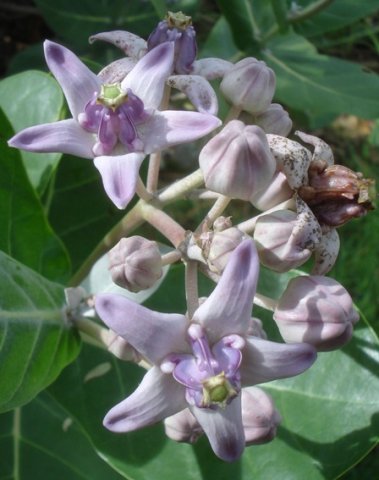
Calotropis gigantea
Author: Ivan Lätti
Photographer: Judd Kirkel Welwitch
Calotropis gigantea is a large, poisonous shrub, an exotic of the Apocynaceae or dogbane family, indigenous in southeast Asian countries including India, China, Thailand and Indonesia, admired in Hawaii. It is occasionally found in South African gardens, particularly in KwaZulu-Natal and Gauteng. Plant parts contain a milky latex.
The simple, opposite leaves are oval, pale green, the margins entire.
The waxy, unscented flowers grow in umbel-shaped cymes. Each flower has five sepals, five white or mauve, spreading petals and a corona in the centre around the staminal column.
Calotropis plants (there are two species), yield a durable fibre used in making ropes, carpets, fishing nets, and sewing thread. Floss, obtained from the seeds, is used as stuffing for pillows. Several plant parts of both species yield substances used in traditional medicine. The latex of the other Calotropis species, C. procera that also grows in Africa, has been used there as an arrow poison. C. procera is also grown in South Africa (iNaturalist; Wikipedia; https://www.sciencedirect.com).