
Albums
Lippia javanica
Author: Ivan Lätti
Photographer: Ivan Lätti
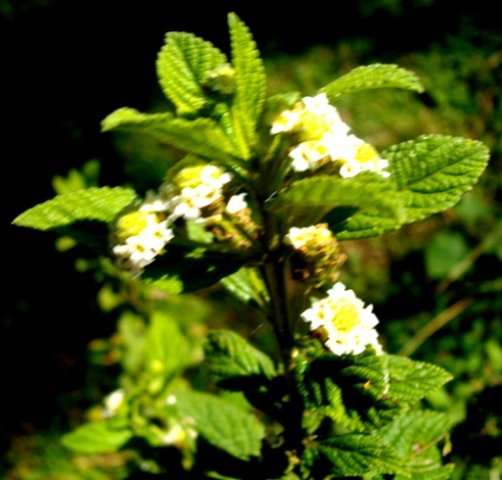
Lippia javanica, commonly known as fever tea, is an erect, woody shrub growing square stems (seen in cross-section) reaching 2 m in height. The hairy leaves are lanceolate to oblong and rough with conspicuous veining. They invite passersby to pick and crush a leaf for smelling the pleasant verbena fragrance.
Dense, rounded flowerheads comprising small white flowers are seen in summer and autumn. The corolla has four white or cream coloured lobes. The stamens are contained within the corolla tube.
The species distribution ranges over much of the east of South Africa, all provinces barring the Western Cape and the Northern Cape. It does not occur in the winter rainfall area, but it extends beyond the border as far as central Africa in Uganda and Ethiopia, and beyond Africa.
The habitat is grassland, sourveld, thicket and bushveld. The habitat population is deemed of least concern early in the twenty first century.
The javanica specific name was conferred, maybe incorrectly, as some sources have it that the plant does not grow naturally on the island. The tropical rainforest climate of Java is very different to the plant’s South African habitat (Van Wyk and Malan, 1997; Blundell, 1987; Wikipedia; iNaturalist; https://pza.sanbi.org; https://treesa.org; http://redlist.sanbi.org).