
Albums
Firebreak
Author: Ivan Lätti
Photographer: Wikus Riekert
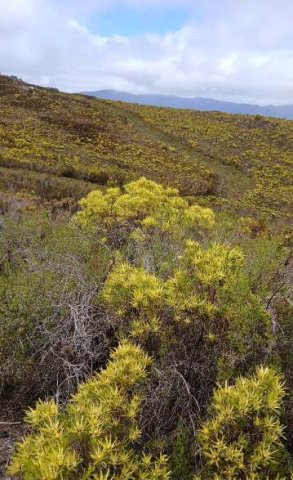
The yellow of this Leucadendron-dominated fynbos patch shows how veld can be dominated by one species. A few kilometres further, and the species mix may be something else. Seasons and regions show manifold fynbos faces, as do the shortness, newness of the veld since the last fire.
To prevent fires from too frequent total removal of the above-ground component of fynbos, veld management is continual, including firebreaks. How wide should they be for stopping a fire? The answer generates much debate affected by notions of the likely wind on the day of the burn. Veld fires also generate their own wind, accelerating what wind blows near the flames. The length and quality of access roads for the firefighting teams to arrive in time, the alertness in monitoring of first smoke, and other factors influence whether the breaks were adequate.
Backburning from the firebreak under carefully assessed situations sometimes allows the firefighting team to control their secondary fire moving in the desired direction… if all goes well! Backburning involves deliberately burning vegetation ahead of advancing wildfire, for the main fire to run out of fuel when it reaches the burnt strip, presenting a cleaner strip than the advance cutting of vegetation. Planning turns into quick thinking when the wind turns or gusts unexpectedly, multiplying risk and indicating that the backburn was a bad idea on the day.
Nature causes fewer fires than people. So, to avoid too frequent burning of the fynbos, all fires are fought, hopefully by skilled teams. Burnt fynbos is the blackest of births painted green by first rain. Just wait!