

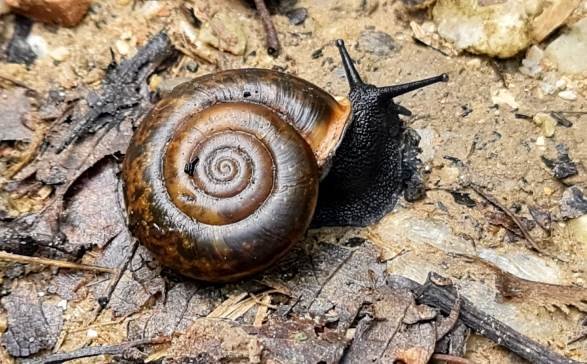
Snail, a local of forest floors
Author: Ivan Lätti
Photographer: Uri Mitrani
This snail has a flat-topped shell that coils clockwise, as shells of many land snails do. It differs in shape from the common garden snail that is so unloved by many South African gardeners.
Our garden snail, Cornu aspersum, was introduced here from Europe. That was another of the unplanned, manmade species introductions, otherwise called biodiversity failures that citizens from time to time bequeath to the generations to come. (Universally: But it wasn’t me!)
The garden snail may have travelled to South Africa frequently, and may still do, commonly hidden in plant shipments, soil, or agricultural produce. Another origin story to add: The garden snail is widely eaten in Europe and was historically moved around the world for that purpose. The literature is sparse on whether South Africa was also “blessed” with this deliberate brilliant move.
The genus of African snails known as Chondrocyclus has seven species indigenous in South Africa, and some in Africa. These snails live on forest floors among decaying wood or leaf litter. They are literally litter-dwellers, restricted to indigenous forest and moderately moist thicket habitats. It is doubtful whether many of them are seen in gardens (Cole, et al, 2019: Molecular phylogeny of Chondrocyclus (Gastropoda: Cyclophoridae), a widespread genus of sedentary, restricted-range snails. Molecular Phylogenetics and Evolution vol 131, pp 193-210; https://www.animalfactfiles.info).