
Helichrysum petiolare
Author: Ivan Lätti
Photographer: Carina Oosthuizen
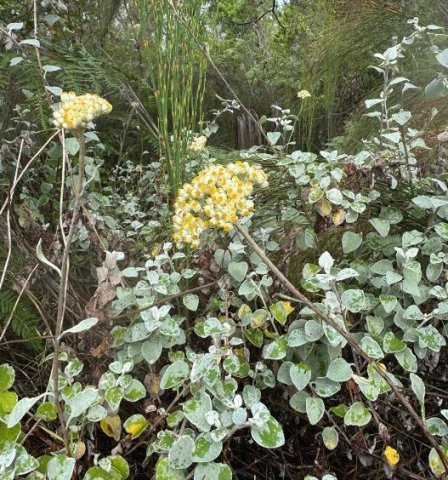
Helichrysum petiolare is a spreading shrub that branches much, reaching heights around 1 m. The soft, aromatic plant is single-stemmed, does not resprout after fire.
A profusion of alternate, ovate to rounded, woolly grey leaves characterises the bush. The photo illustrates how the woolly leaf coverings can easily be rubbed off partially from contact with other objects.
The numerous clusters of small, bell-shaped flowerheads are creamy, produced above the leaves from late spring to after midsummer.
The species distribution is in the Western Cape from the Cederberg, the coastal region near Mossel Bay and the Little Karoo to the Eastern Cape as far as Humansdorp. The photo was taken in the Eastern Cape near the sea.
The habitat is moist, shady lower slopes and forest margins, coastally and slightly inland. The habitat population is deemed of least concern early in the twenty first century.
A group of related Helichrysum plants, this one and others like H. cymosum, H. patulum and H. crispum are sometimes commonly called kooigoed in Afrikaans, meaning bedding material. This term was commonly used in the Western Cape and southern Cape by veld travellers that slept on mattresses of these bushes. The soft plant material was widely used, probably wherever the plants were available, and some may still do this today. Softness is immediately evident, but the plant aromas keeping insects away are also much appreciated.
Medicinal uses of these plants by locals are also on record, while H. petiolare is a popular garden plant (Vlok and Schutte-Vlok, 2015; Manning 2009; Bond and Goldblatt, 1984; iNaturalist; http://redlist.sanbi.org).