
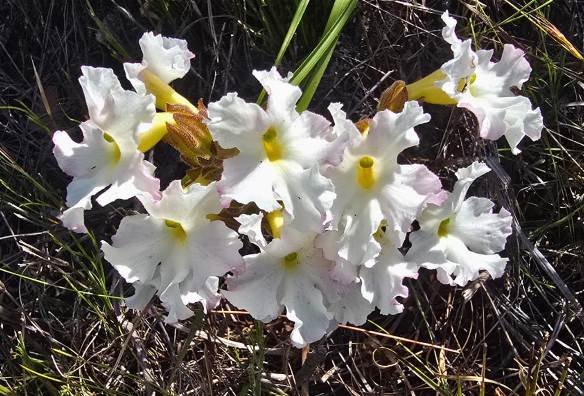
Harveya capensis in flower
Author: Ivan Lätti
Photographer: Wikus Riekert
This Harveya capensis plant is flowering exuberantly in November near Hermanus. The pointed and centrally ridged sepals are brown and hairy, small around the corolla bases. The expanding funnel-shapes of the corollas are dull yellow on their outsides. There is also some yellow in the flower mouths.
The two-lipped, flaring corollas surround the tube mouths with elaborately wavy lobe margins, sufficiently marketing available food to nocturnal insects on the wing. The flower fragrance also helps. Nature often doesn’t skimp when it comes to species survival requirements. Some people out after dark find the sweet fragrances romantic.
None of the other Harveya species that produce white flowers occur in this region. They are H. speciosa, H. roseoalba, and some forms of H. purpurea.
Plant parts of H. capensis turn black when bruised or drying (Euston-Brown and Kruger, 2023; Curtis-Scott, et al, 2020; Vlok and Schutte-Vlok, 2015; Manning, 2007; iNaturalist; https://www.fernkloof.org.za; http://redlist.sanbi.org).