
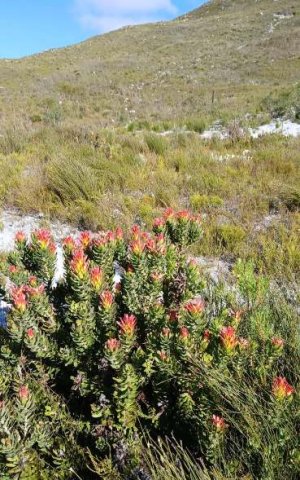
Mimetes cucullatus resprouter headstart after fire
Author: Ivan Lätti
Photographer: Wikus Riekert
This Mimetes cucullatus bush near Hermanus shows the early size advantage enjoyed by a fynbos resprouter plant after fire. It flowers before the perennial species that die in the fire and have to regrow from seed can produce significant new vegetative material. If a plant part is left alive and viable underground, the species sprouts in the next growing season, boosted by rain. Most of the restios also resprout in the fynbos, especially in the wetter regions.
Resprouting provides earlier food for the insect, bird and mammal populations of the region, the pollinators needed by the plants. Soon after the fire these populations are seriously disadvantaged by the lack of food and shelter, i.e. those that were not killed by the fire. Annuals and geophytes, also being fast out of the blocks, contribute to early veld recovery, particularly ensuring food availability to animals all sorts. Stabilising the topsoil, another priority, happens faster from these early performing plant species in new veld, particularly when the rain isn’t late, or does not arrive in deluge amounts too quickly.
In the Western Cape fynbos, the Mediterranean climate brings fire in the hot dry summer, rain in winter. This sustains a vastly complex community of species adapted to the ecology of the seasonal cycle (Vlok and Schutte-Vlok, 2015; Manning, 2009; Wikipedia).