
Dracophilus dealbatus spreading sepals
Author: Ivan Lätti
Photographer: Judd Kirkel Welwitch
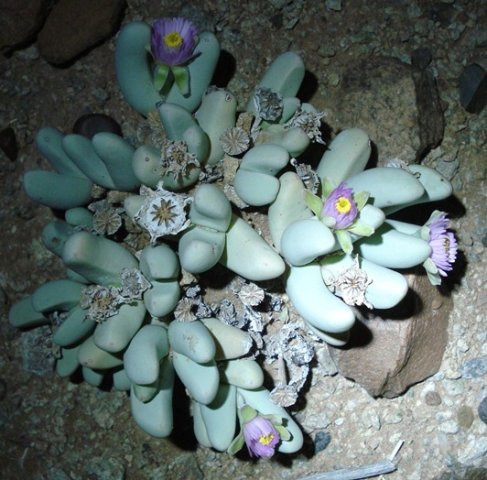
When the petals of Dracophilus dealbatus flowers pout as in the photo, maybe more when it is dark, the sepals get a chance to parade their charms. Like so many sepals in flower world, they normally play second fiddle to petals.
There seems to be ambiguity as to staminodes not only being infertile stamens lacking anthers around the real or fertile stamens in the flower centres, but in mesembs also structurally including the petals around the stamens.
Be that as it may, when the petals converge around the stamens as in the photo, the greener, flatter and more round-tipped insides of the spreading sepals are more on display. Some of these sepals ascend, others sag. In one of the flowers on show there seems to be six sepals present, instead of the normally expected five. Whoever wins that argument might in any case declare this a lesser abnormality within the range of what should be expected in nature, therefore no fuss.
The older retained fruit capsules in the photo have no leaves around them. This shows that leaf pairs shrivel up after the flowers in their midst fade, but the dry capsules persist erectly for longer on the resilient dry branches. This is useful for ensuring that the last seeds are released from the capsules, even if rain takes a long time to arrive (Smith, et al, 1998; iNaturalist; https://www.worldfloraonline.org).