
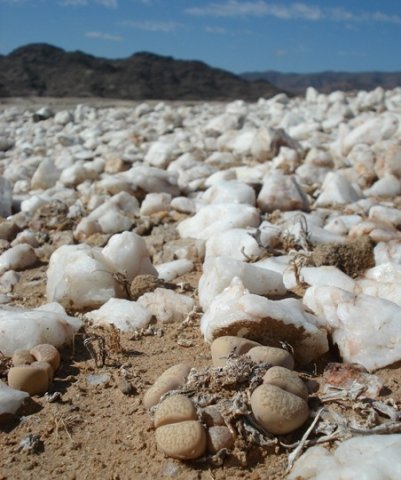
Lithops herrei at home
Author: Ivan Lätti
Photographer: Judd Kirkel Welwitch
Growing in a field of quartzite pebbles not too far from the Gariep River, a Lithops herrei plant may be fairly safe in habitat or not. This is, at least, the place where the species has been holding its own for untold generations over centuries since splitting from its parent species.
Observers may assess a plant’s survival risk from counting specimens and their geographical distribution, repeatedly over longish intervals, determining species population stability. What may appear as harsh conditions are not really the case for a given species, as long as its population remains stable and healthy over time. Living things adapt to different sets of challenges, often alien to the observer from a different comfort zone.
Changes that threaten a species may, however, start imperceptibly in its environment, such as the climate hotting up, or drying out more than the plant is adapted to. More visible changes also happen, such as plant removal or trampling by other species. Some changes come from pollution, mainly caused by people in our time, affecting air, water or soil. All such things affect the population number stability of a species. As its numbers decrease, a species may be regarded as vulnerable, threatened, or approaching extinction. Extinct species no longer impact on the residual mix of living things that survive into the future.
The finite earth needs looking after! Ironically now mainly by its most dominant and abrasive species, humanity. Earth in a particular condition, its life supporting variables sustained in the right, narrow intervals, is the key asset shared by all the numerous living beings found here. All of them have this vital interest in earth, its carrying capacity for all their evolving descendants, tomorrow's living entities, whatever they turn out to be.