
Pelargonium schlechteri
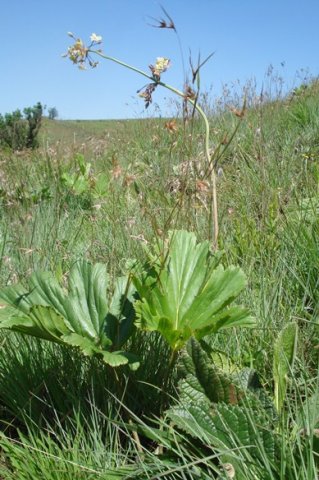
Author: Ivan Lätti
Photographer: Judd Kirkel Welwitch
Pelargonium schlechteri, commonly the two-tiered pelargonium and previously scientifically P. flabellifolium, is a low-growing, stemless perennial reaching about 60 cm in height. The deciduous, hairy plant grows from a woody tuber. It resembles P. luridum to the extent that it may be regarded as a form of that species.
The simple, alternate leaves of P. schlechteri are broadly ovate and deeply, angularly lobed with truncate bases. The lobe tips are toothed, the margins faintly hair-fringed. The leathery green blades are prominently veined. Leaf dimensions are from 12 cm to 19 cm long and from 14 cm to 28 cm wide. The petioles are up to 24 cm long.
The species distribution is in the east of South Africa, from the north of the Eastern Cape, the east of the Free State, the KwaZulu-Natal Drakensberg and some montane parts of Mpumalanga. The photo was taken in Mpumalanga.
The habitat is steep, rocky grassland slopes at high elevations, up to 2400 m. The plants are often found in deep soil along streambanks or near boulders. The species is not recognised by SANBI, so information could not be found on the status of the habitat population. P. luridum, of which this plant may form part, is sometimes also commonly called the variable stork’s bill, and its future in nature deemed of least concern early in the twenty first century (Pooley, 1998; iNaturalist; https://www.pelargonium.si; http://redlist.sanbi.org).