
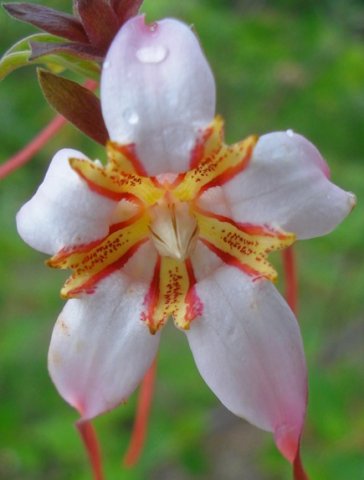
Strophanthus luteolus flower
Author: Ivan Lätti
Photographer: Judd Kirkel Welwitch
The five-lobed Strophanthus luteolus flower is white or cream inside the corolla cup, purplish or marked so on the outside. The five red-margined yellow bands visible inside the cup, red dots down the centre, are nectar guides for the benefit of pollinators, likely to be bees and butterflies.
The corolla cup has long petal-tails, elongated, thread-like lobe-tips that coil and trail down conspicuously from the flower. These tails are from 5 cm to 8 cm long, reddish here and sometimes yellowish. The generic name, Strophanthus, is derived from the Greek words strophos meaning a twisted band and anthos meaning a flower, referring to the petal tails of the flowers.
The staminal cone in the flower centre is erect, closed at its top with gaps between, as the five anthers stand upright, touching each other at the top in forming the cone. The dome-shaped style head is inside this conic structure, the ovary further down in the base of the tube, well out of sight.
Flowering happens in summer to early autumn.
The fruit is a long, two-horned or paired follicle, the horns angled apart and tapering to thickened tips. A fruit is up to 47 cm long and 3,5 cm in diameter. The seeds are spindle-shaped with hair tuft attachments (Coates Palgrave, 2002; Pooley, 1998; Germishuizen and Fabian, 1982; iNaturalist).