
Ebracteola
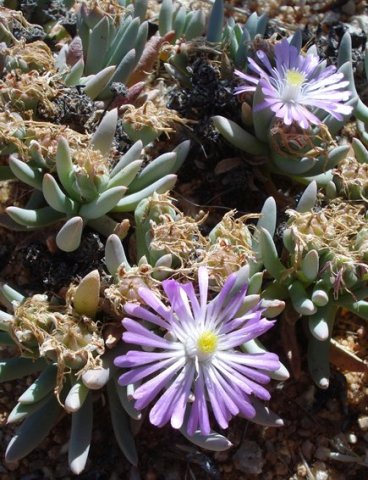
Author: Ivan Lätti
Photographer: Judd Kirkel Welwitch
Ebracteola is a small genus of dwarf succulents in the Aizoaceae or mesemb family. The compact, tufted plants have thick, tapering taproots, swollen from storing moisture. The above-ground parts form cushions or mats from short, much-branched stems, prostrate or nearly so, with few leaf pairs to a stem.
The opposite, decussate and equal leaf-pairs are joined at the base, tapering to distinctly pointed tips. The smooth leaf surfaces are grey green to blue green, sometimes developing some red from sunlight, and sometimes dotted green or black. The thickly succulent leaves are keeled distinctly to roundly on the outside.
The short-stalked flowers grow solitary at stem-tips, appearing sessile. The Ebracteola generic name indicates the absence of bracts on the flower stalks, although tiny bracts are indeed present but low down. There are five free sepals to a flower. The flowers are purple in different shades or white, sometimes only white near the petal bases. The purple tends to fade to pink. The flowers have only one whorl of petals that spread to about 2,5 cm. They open late morning and close at dusk.
The central cone of stamens have linear filaments, surrounded by staminodes. There is a wavy ring of nectar glands in the flower base. The ovary has five awl-shaped stigmas and five locules; the placentas attached to the outside walls of the chambers.
Flowering happens mostly from late winter to spring or early summer.
The fruits are five-loculed capsules with broad expanding keels, narrow valve wings and hook-shaped closing bodies. The covering membranes are stiff. Old capsules persist on the plant for years. The nearly spherical seeds are whitish and smooth.
There are four Ebracteola species, all occurring in southern Africa, and three of them in South Africa. The plants respond well in cultivation, particularly in shaded, frost-protected environments, propagating easily from seeds or cuttings.
The plant in picture is Ebracteola fulleri (Leistner, (Ed.), 2000; Williamson, 2010; Smith, et al, 1998).