
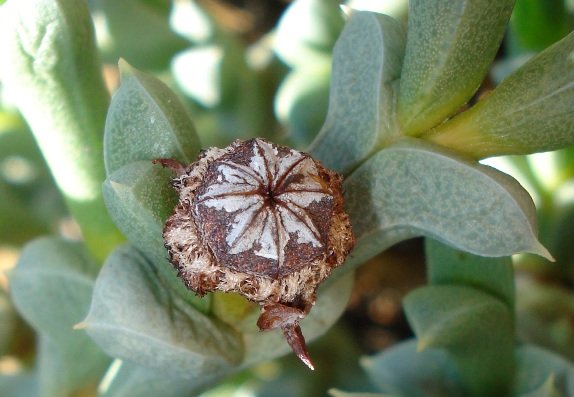
Schlechteranthus albiflorus capsule
Author: Ivan Lätti
Photographer: Judd Kirkel Welwitch
The Schlechteranthus albiflorus fruit capsule in picture displays eight neat isosceles triangles formed by the valve tops. There are sometimes more of them on a capsule. Together these valves form a ring-shaped cover over the locules, their small angle tips joined in the centre.
Already dry here, the decaying covers show whitish margins from where the old skin has been lost, once young and fleshy. To the outside of the triangles, an uneven outer ring of decayed sepals still surrounds protectively, as they did from earliest growth. The capsule top is slightly domed. Some seeds may still be inside.
The dried valves respond to moisture. Every time it rains they open in a hygroscopic action as if still alive. Opening when wet, they remain so until dry, then close. This allows for intermittent releasing of ripe seeds from the locules, bounced or flooded out by raindrops. Moist for germination, the seeds end up wherever the rain leaves them. Some grow, and life goes on where it can. This process is repeated whenever moisture touches the capsule again, releasing more seeds until the capsule is empty (Smith, et al, 1998; iNaturalist).