
Oscularia
Author: Ivan Lätti
Photographer: Judd Kirkel Welwitch
Oscularia is a genus of densely branched leaf succulent shrublets in the Aizoaceae or mesemb family. The genus previously formed part of Lampranthus. The many reddish stems are erect or spreading. The common name of sandsteenvygie (sandstone mesemb) may have taken root for the genus.
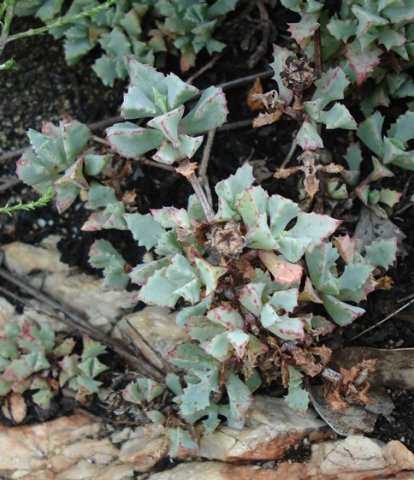
The opposite leaf pairs, joined at the base, are nearly identical, thickly succulent and triangular from prominent keels. The margins and keels are prominently toothed. The grey green to pale blue blade surfaces are waxy. Leaves are up to 2 cm long and 1,3 cm wide. The generic name Oscularia is a Latin word meaning group of tiny mouths, referring to the appearance of the toothed leaves in some species. Imagination may be required.
The almond-scented flowers grow solitary or in groups on pedicels with two bracts each, or rarely, stalkless. There are five fleshy sepals and slightly more than one whorl of white or pink petals. A central cone of stamens and staminodes is erect in each flower centre. There is a nectary of five wavy glands in the flower base for the benefit of pollinators. The ovary is convex to conical on top, its placentas where the ovules grow inside the outer walls. There are five stigmas in a flower hidden by the stamens. The flowers open in the morning and close at night. Flowering happens from winter to early summer.
The brown to grey, five-locular fruit capsule is of the Lampranthus type with expanding keels that diverge from the base, over half as long as the valves. The broad valve wings are rectangular. The covering membranes have small closing ledges, but there are no closing bodies. The ovoid seeds are brown and warty.
There are 23 Oscularia species, all in the Western Cape and some in the Northern Cape, growing in sandstone derived, rocky and arid places.
The plant in picture is Oscularia deltoides, probably the best-known garden species in the genus (Leistner, (Ed.), 2000; Smith, et al, 1998; Wikipedia).