
Nymania capensis fruit colour purpose
Author: Ivan Lätti
Photographer: Francelle van Zyl
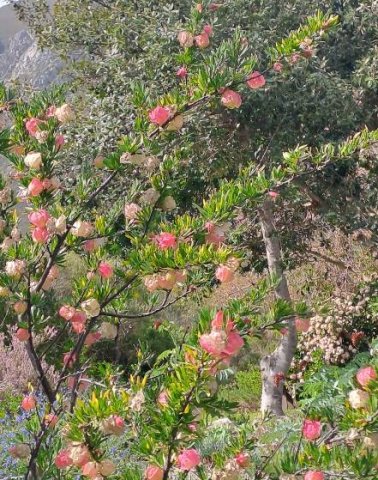
The smooth, woody branches of a Nymania capensis bush may be sparse and willowy in the upper parts of the mature plant. Graceful allure is added by the swollen fruits dotted unevenly among the erect leaves.
The busy, festive look is enhanced by the colour differences among the scattered fruits. Illusion hides the fact that only two basic colours are present: rose-red and white-beige, signifying still fleshy and already dry. As the seeds inside are only ready for dispersal when the balloons have lost colour, the bright colouring is not a fruit dispersal evolutionary trick. Many fruits bear bright colours as enticement, calling out to be eaten so that their seeds may be scattered. These whitish and papery N. capensis balloons containing ripe seeds may fly or bounce about when breaking off, dispersing seeds to random germination sites. And so the dry balloons prove their worth.
The colourful ones? They trump the flowers in attraction and size. As the blooming season may start with the onset of winter and sometimes lasts until early summer, many young fruits coincide with later flowers on the bush, still requiring pollinator attention. So, the colouring of the unripe fruit does serve, but in its own way. The brightness beckons like neon signs at shop windows (Euston-Brown and Kruger, 2023; Van Rooyen and Van Rooyen, 2019; Vlok and Schutte-Vlok, 2015; Van Wyk and Van Wyk, 1997; iNaturalist).