
Strelitzia
Author: Ivan Lätti
Photographer: Francelle van Zyl
Strelitzia is a genus of fleshy perennials and banana-like trees in the Strelitziaceae or crane flower family. The family belongs in the order Zingiberales, the members of which are largely tropical, including the bananas, cannas and gingers. Some Strelitzia plants form clumps. Those with stems may sucker, the stems smooth, woody, and brittle, marked with leaf scars.
The leaves are arranged in two vertical arrays on opposite sides of a stem, and sheathing the base, the arrangement a fan-shape. The leathery blades are often elliptic to oblong, large to very large, but sometimes reduced to bladeless petioles. The petioles are mostly channelled, up to 2 m long.
The inflorescences grow on peduncles from leaf axils, and are based on leathery, boat-shaped spathes. Inflorescences are in cyme form. Each successive flower or branch of flowers arises alternately on opposite sides of the inflorescence axis that zig-zags or is slightly coiled.
The bisexual flowers are irregular in shape, large and conspicuous. Each perianth has six parts: three sepals, often orange, and three petals, often blue. The lowest of the three petal-like sepals is boat-shaped at the base, and keeled, attenuating as the other two. Two of the three, almost free petals are together low down in an arrow-shape or beak. The pair forms a central channel where the thin stamens and thread-like style reside. The third, upper petal is smaller and frilled, inconspicuous. There are five stamens. The inferior ovary has three locules, each containing numerous ovules. The three stigmas occur on the three style branches.
The fruit is a three-angled, woody capsule. The few globose seeds per capsule have woolly, orange arils.
There are five Strelitzia species, all growing naturally in the east of southern Africa. Several species are internationally much planted in parks and gardens of warmer areas.
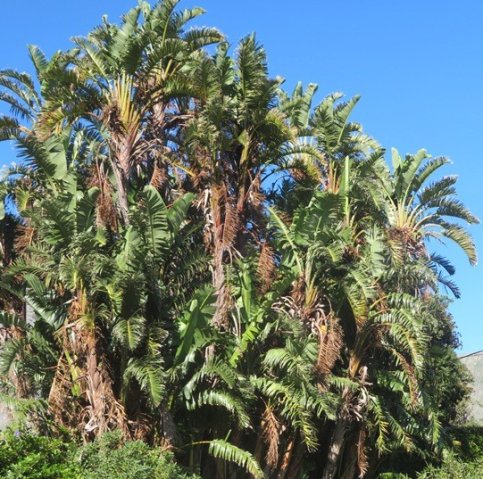
The plant in picture is Strelitzia nicolai growing near Hermanus (Leistner, (Ed.), 2000; Manning, 2009; Coates Palgrave, 2002; Pooley, 1998; Pooley, 1993; Wikipedia).